
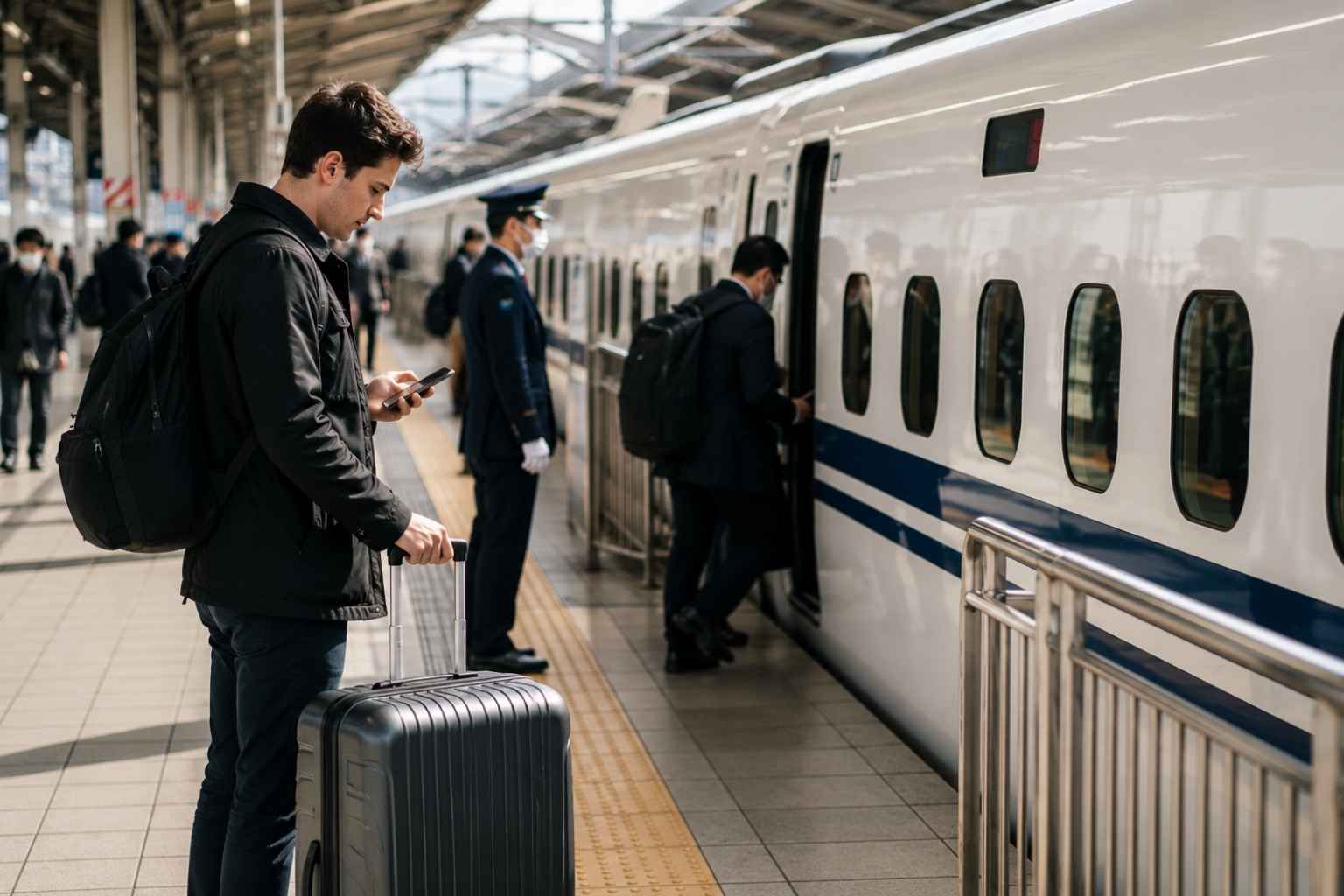
The shinkansen oversized baggage reservation rule is already in force on major Shinkansen routes, and travelers with large suitcases can be charged an onboard fee if they show up without the right seat. This affects passengers carrying bags with total dimensions from 160 cm up to 250 cm on the Tokaido, Sanyo, Kyushu, and Nishi-Kyushu Shinkansen. It matters now because one oversized suitcase can turn a smooth bullet train ride into a last-minute seat problem, a ¥1,000 baggage fee, and a forced bag relocation away from you.
That is the part many first-time visitors miss. The issue is not just bag size. It is that the train system links certain large bags to certain reserved seats, and if you do not lock that in before boarding, the train crew can still let you travel but not on your own terms.
Shinkansen Oversized Baggage Reservation: What Happened
Japan’s major Shinkansen operators now clearly state that baggage with total dimensions of more than 160 cm and up to 250 cm requires advance reservation. JR Central says passengers bringing oversized baggage onto the Tokaido-Sanyo-Kyushu Shinkansen need to reserve a seat with an oversized baggage area, while JR West’s English guide states the same rule for the Tokaido, Sanyo, Kyushu, and Nishi-Kyushu Shinkansen.
The size cutoffs are the key numbers travelers need to remember. Up to 160 cm total dimensions is allowed without special reservation. Between 160 cm and 250 cm is treated as oversized baggage and needs the correct reserved seat. Over 250 cm is not allowed onboard.
That means a standard large international suitcase can easily fall into the reservation zone. JR Central explicitly says the 160 cm to 250 cm range is roughly the same size category that triggers oversized baggage fees on international flights, which makes the rule especially relevant for foreign travelers arriving with full-size check-in luggage.
There is also a practical detail many travelers miss: not every reserved seat solves the problem. JR West says oversized baggage is not allowed in non-reserved seats and not all reserved-seat cars have oversized baggage areas or compartments. Some trains do not have those seats at all, which is why checking the seat map matters.
Who This Affects
This mainly affects international tourists moving between major cities with airport-size luggage. It also affects students, long-stay visitors, families with large cases, and anyone trying to move fast between Tokyo, Kyoto, Osaka, Hakata, or Kagoshima without thinking about suitcase measurements first.
You should pay close attention if you are:
- carrying a large checked suitcase rather than a compact cabin bag
- riding the Tokaido, Sanyo, Kyushu, or Nishi-Kyushu Shinkansen
- booking non-reserved seats to save time or money
- making a transfer and assuming any later train will work
- traveling during peak periods when the right last-row seats can sell out sooner than standard seats
There are a few notable exceptions. JR West says the oversized baggage rules do not apply to strollers, sporting goods, instruments, and similar items, even when they exceed 160 cm. But it also says that if you want to use the oversized baggage area or compartment for those items, you should still reserve the correct seat.
Another point that matters for travelers with more than one bag: JR West says you may bring up to two baggage items, with a weight limit of up to 30 kg and total dimensions up to 250 cm, but oversized items still need the reserved baggage space setup.
Why This Matters for Travelers
The biggest reason this rule matters is that the penalty is avoidable. JR West says there is no extra charge for reserving a seat with an oversized baggage area or an oversized baggage compartment. But if you bring oversized baggage without that reservation, you are charged a ¥1,000 baggage fee and the crew will require you to store the bag in a designated area.
That changes the risk calculation completely. This is not a situation where paying later buys you the same convenience. It buys you less control. Your bag may be moved away from your seat, and you may still have to deal with the hassle after already paying the onboard fee.
It also matters because the correct baggage seat is part of your broader seat reservation strategy. SmartEX says that when you are making a transfer, you must reserve the seat with oversized baggage area for the entire trip and cannot rely on non-reserved seats. It also warns that the general seat-availability screen may show the train has seats, while the actual oversized baggage seats may already be gone.
For some trains, travelers now have two storage-style options instead of one. JR West says last-row seats with oversized baggage areas remain the main option, while oversized baggage compartments are also available on some Tokaido and Sanyo Shinkansen 16-car trains. Those compartments are in the deck area near the seat, use locks, and have their own size limits.
Those compartment limits are smaller than many people expect. JR West says lower-level compartments fit baggage up to 80 cm × 60 cm × 40 cm, while upper-level compartments fit up to 80 cm × 60 cm × 50 cm. If your bag is too large for the compartment, you need the regular oversized baggage area behind the last row instead.
[Why Some Japan Restaurants Quietly Turn Tourists Away]
What To Know Before You Go
Before boarding, do these checks in order:
- Measure your suitcase by adding length, width, and height.
- If the total is under 160 cm, you do not need a special baggage reservation.
- If the total is 160 cm to 250 cm, reserve a seat with an oversized baggage area or compartment before boarding.
- If the total is over 250 cm, do not plan to bring it onboard. Use a luggage delivery service instead.
You can book the correct seat in several ways:
- online through SmartEX, JR-WEST ONLINE TRAIN RESERVATION, or JR-KYUSHU Train Reservation
- at station ticket-vending machines
- at a JR ticket office by telling the staff you are traveling with oversized baggage
If you use SmartEX, the platform says you should choose “Seat with Oversized Baggage Area” during the search flow. It also says these seats cannot be reserved through after-hours or pre-sale requests and should be booked when tickets go on sale, which is one month before departure.
One more practical detail: last-row baggage areas are shared. JR West says the space behind those seats is shared among passengers who reserved them, so large groups or travelers with multiple bulky items should not assume unlimited room.
If the train you wanted is sold out, the official guidance is blunt. JR West says that if you are traveling with oversized baggage and the proper baggage seats are fully booked, you should reserve another train. Trying to improvise with a non-reserved seat is not an official workaround.
Official Note
According to JR Central, JR West, SmartEX, and JR Kyushu guidance, oversized baggage rules apply on the Tokaido, Sanyo, Kyushu, and Nishi-Kyushu Shinkansen. Bags over 160 cm and up to 250 cm require advance reservation, bags over 250 cm are not allowed onboard, and traveling with oversized baggage without the right reservation can trigger a ¥1,000 onboard baggage fee and mandatory relocation of the bag. Travelers should confirm their exact train, seat type, and baggage size before departure.
[The Konbini Shortcut Can Backfire Fast]
The Shinkansen is still one of the easiest ways to cross Japan. But if your suitcase is large enough to trigger the rule, the smooth trip starts before the platform — not after you board.
Question for readers: Have you ever been surprised by Shinkansen luggage rules, or do you now just use luggage forwarding instead?