
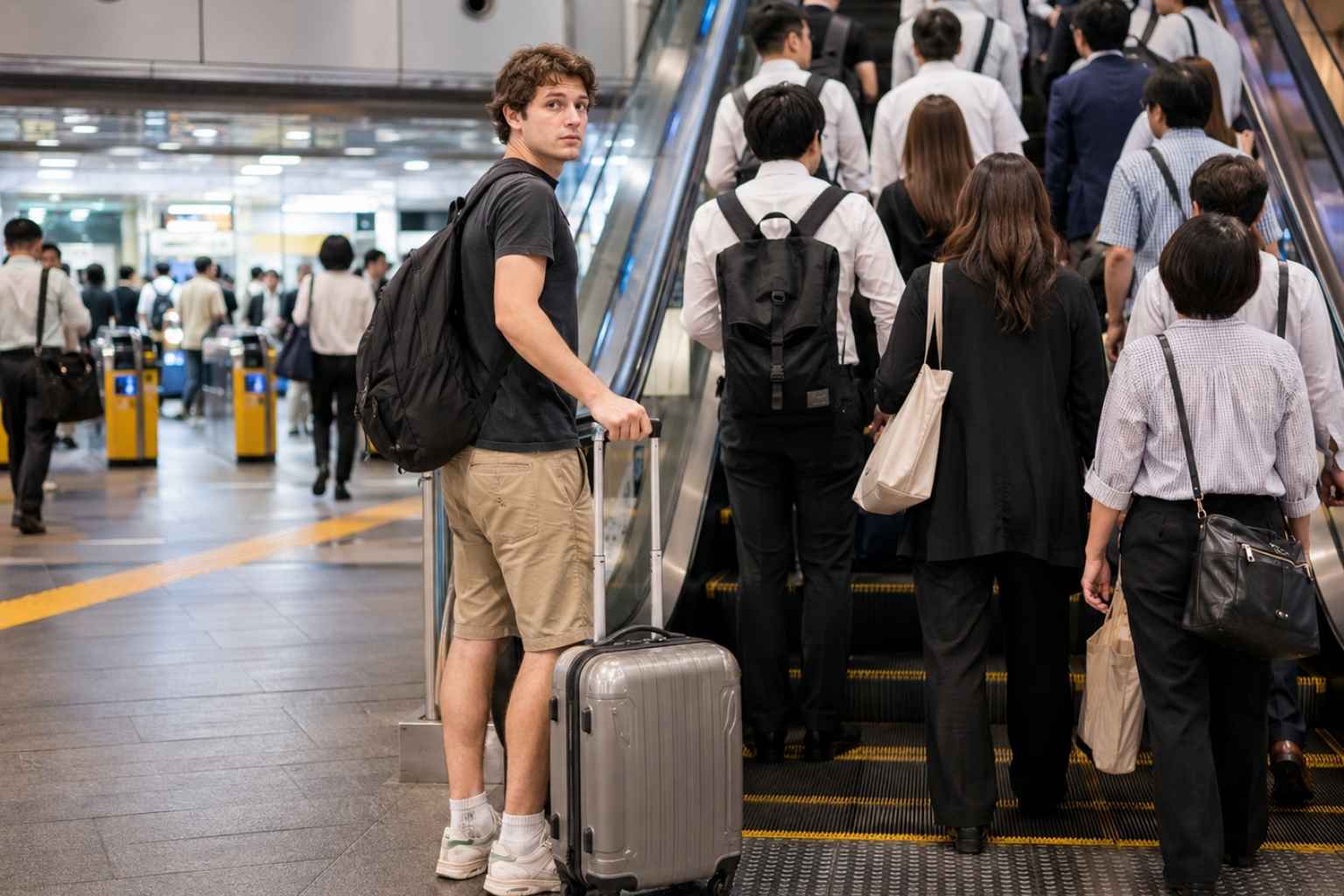
Tokyo and Osaka still follow different escalator habits.
But official safety advice is now pushing riders to stop walking altogether.
Japan escalator etiquette is confusing because the old commuter habit and the official safety message do not fully match. This affects tourists moving between Tokyo, Osaka, Kyoto, Nagoya, and other major station hubs where people expect you to read the flow quickly. It matters now because rail operators and city governments are increasingly telling people not to walk on escalators, even though many commuters still leave one side open by habit.
The practical answer is simple but imperfect: in Tokyo, people have traditionally stood on the left and left the right side open; in Osaka, people have traditionally stood on the right and left the left side open. But the safest current advice from operators is to stand still, hold the handrail, and avoid walking or running on escalators because falls and collisions can happen fast in crowded stations.
Japan Escalator Etiquette: What Happened
For years, visitors learned a simple “Tokyo left, Osaka right” rule. That convention is still widely recognized, and outside observers have long noted that escalator habits differ by Japanese city, with Tokyo commonly using the left-standing pattern and Osaka commonly using the right-standing pattern.
The problem is that official safety messaging has moved in a different direction. JR East now tells passengers: “Don’t walk on the escalator, just stand there,” warning that walking can lead to falls or collisions.
Nagoya has gone even further with a formal local ordinance. The city’s English ordinance overview tells riders to stand still on escalators whether they are on the left or right side, hold the handrail, stay inside the yellow line, and avoid getting on with belongings too big for the escalator.
That creates the real tourist confusion. The crowd may still leave a walking lane open, but the safety message says walking itself is the problem.
Who This Affects
This affects almost every traveler who uses trains in Japan, but especially visitors moving through busy station escalators with luggage, backpacks, strollers, or children. The awkward moment usually happens when a tourist copies the wrong city’s habit or blocks the side people expect to pass on.
You should pay extra attention if you are:
- arriving in Tokyo and heading into major stations such as Shinjuku, Tokyo, Shibuya, Ikebukuro, or Ueno
- traveling from Tokyo to Osaka or Kyoto and forgetting the regional habit changes
- carrying a suitcase or large backpack on an escalator
- riding during morning or evening rush hour
- trying to walk up or down because you are late
- stopping at the top or bottom to check your phone
- visiting Nagoya, where official guidance specifically tells riders to stand still on either side
This is not usually about someone shouting at you. It is more often about subtle pressure: people bunching behind you, moving around you, clearing their throat, or giving the kind of look that says you have blocked the flow.
Why This Matters for Travelers
Japanese stations work because people move predictably. A small mistake on an escalator can create a bottleneck quickly, especially when hundreds of commuters are trying to transfer between platforms.
The old side rule helped commuters maintain rhythm. In Tokyo, the left side became the usual standing side. In Osaka, the right side became the usual standing side. But official safety bodies increasingly want riders to stop treating escalators like stairs, because walking and running can cause injuries, especially when people are carrying bags or standing close together.
That means tourists need to understand two realities at once. The local crowd habit still matters if you are trying not to block people. The official safety rule also matters if you want to avoid risky behavior.
The best practical approach is not to race anyone. Stand still, hold the handrail, keep your luggage tight, and copy the stationary side of the people directly in front of you.
[Tattoo-Friendly Onsen Near Tokyo: Where Travelers With Ink Can Actually Soak]
Tokyo vs Osaka: Which Side to Stand On
In Tokyo and much of eastern Japan, the common commuter habit is to stand on the left. The right side has traditionally been left open for people walking past, although rail operators now discourage walking on escalators for safety reasons.
In Osaka and much of the Kansai area, the habit flips. People commonly stand on the right, leaving the left side open by local convention. This is why visitors who ride the Shinkansen from Tokyo to Osaka can make a mistake immediately after arrival: they carry the Tokyo habit into a city that moves differently.
Kyoto can feel less consistent to visitors because it receives heavy tourist traffic and sits within the Kansai region, where Osaka-style habits are common. The safest move is not to memorize a theory before every station, but to pause for one second and copy the line forming in front of you.
Nagoya is different again because the official city message is clearer: stand still whether you are on the left or right side. The city’s ordinance overview directly says walking or running up and down escalators is dangerous because it can cause accidents by falling or bumping into other users.
What To Know Before You Go
The easiest rule for tourists is: follow the crowd, but do not rush. If the crowd is standing left, stand left. If the crowd is standing right, stand right. If signs or staff ask people to stand on both sides, follow the posted safety request.
Use this quick city-by-city habit check:
- Tokyo: traditionally stand left, but official rail safety advice says do not walk.
- Osaka: traditionally stand right, but safety campaigns still discourage walking.
- Kyoto: often follows Kansai habits, but tourist flow can vary by station.
- Nagoya: official ordinance guidance says stand still on either side.
- Other cities: watch the first few people in front of you and copy them.
If you are carrying luggage, keep it directly in front of you, behind you, or beside you without blocking another rider’s path. Nagoya’s ordinance overview specifically warns against getting on escalators with belongings too big for the escalator, and it tells riders to keep hold of suitcases.
Do not stop immediately after getting off. This is one of the most dangerous mistakes because people behind you are still moving upward or downward. Nagoya’s guidance explicitly says not to stop after getting off an escalator and to keep walking.
Also avoid looking down at your phone while stepping on or off. Escalator timing, luggage wheels, and station crowds are a bad combination, especially when people behind you cannot stop quickly.
[Welcome Suica Card 2026: What Tourists Must Know Before Buying an IC Card]
The Safest Rule When You Are Unsure
When you do not know the local habit, pause before stepping on. Look at the three people directly ahead of you. If they stand left, stand left. If they stand right, stand right. If people are standing on both sides under a safety campaign, do the same.
The goal is not to be perfect. The goal is to avoid becoming the person who blocks the escalator, swings a backpack into someone’s body, lets a suitcase roll backward, or stops at the top while checking directions.
This is where Japan escalator etiquette is less about “left or right” and more about awareness. Local habits help you blend in, but the safest behavior is to stand still, hold the rail, control your luggage, and keep moving after you step off.
Official Note
JR East’s official safety request says not to walk on escalators because walking can cause falls or collisions. Nagoya’s official ordinance overview tells riders to stand still on either side, hold the handrail, stay inside the yellow line, and avoid walking or running up and down escalators. The Tokyo-left and Osaka-right pattern remains a widely recognized commuter habit, but travelers should treat official station signs, staff guidance, and local crowd flow as the rule on the day they travel.
Japan’s escalator habits can feel like a tiny detail, but small details matter in crowded stations. Stand where the local line is standing, do not walk when signs tell you not to, and keep your luggage under control so your transfer stays smooth.
Question for readers: Did you first learn the Tokyo-left and Osaka-right escalator difference the easy way, or by accidentally blocking everyone behind you?