
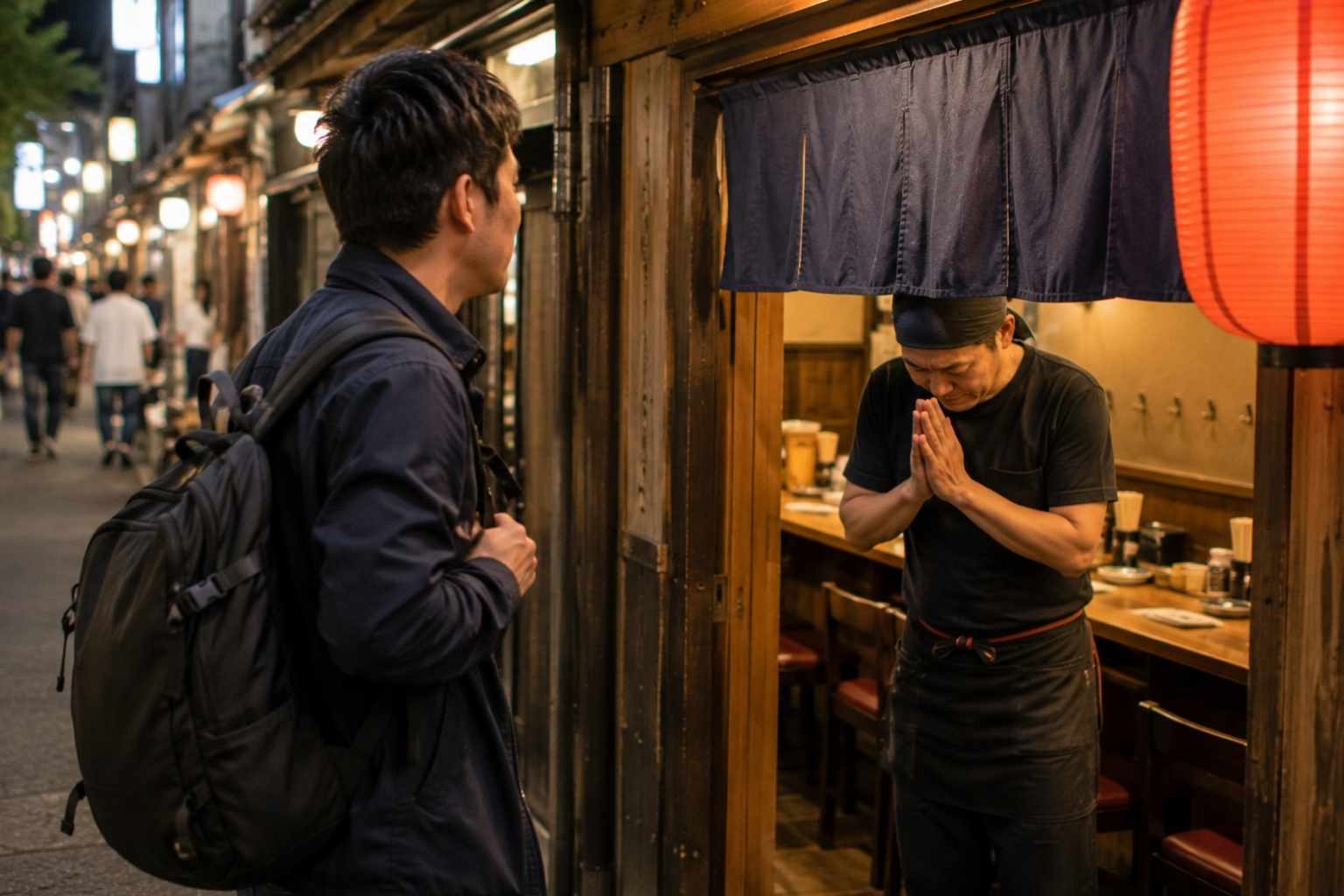
It can feel personal when a restaurant in Japan says it is full while you can still see seats inside.
But in many cases, the problem is not hostility. It is a mix of reservation culture, small-space operations, photo rules, communication stress, and dining customs tourists often do not spot fast enough.
The reason Japan restaurants turn away tourists is often less dramatic than it looks from the street. It usually affects walk-in visitors at small restaurants, diners who do not check house rules, and travelers who expect every empty-looking seat to be available immediately. It matters now because official Japan travel guidance says many restaurants in popular downtown areas need reservations, while some high-demand dining neighborhoods rarely accommodate walk-ins at all.
That means the invisible barrier many visitors feel is often operational before it is cultural. A place may look half-empty but still be holding seats for timed reservations, set-course pacing, or later guests, especially in compact dining districts where every seat matters. This is one reason walking in cold can fail even when the room does not look packed.
What Happened
Japan’s tourism guidance now openly tells travelers to plan ahead for restaurants, not just trains and hotels. JNTO says many restaurants, especially in the downtown areas of the most popular destinations, typically need reservations, and the MICHELIN Guide says walk-ins in Tokyo’s Araki-cho are “rarely accommodated.”
That changes how a refusal feels. What sounds like “Sorry, full” may sometimes simply mean the restaurant is reservation-led, has tightly managed seating times, or is not structured to absorb random walk-ins without throwing off service.
The communication side can also be real. One restaurant booking page on TableCheck explicitly asks foreign customers whether they can speak Japanese and gives “No (English only)” as a selectable answer, which shows that some venues are actively screening for communication comfort before service even starts. That does not prove a blanket anti-foreigner policy, but it does show why language stress can become part of the decision at small or highly specific places.
Photography is another pressure point. JNTO’s FAQ says some stores and facilities display no-photography signs, Kyoto’s official responsible-travel guidance says photography is prohibited in some restaurants, and restaurant reservation pages increasingly spell out limits such as “food only,” no staff photos, and no livestreaming.
Who This Affects
This hits hardest if you are dining spontaneously, relying on social media lists, or assuming every small izakaya works like a casual walk-in bar. It also affects travelers who do not expect hidden-feeling charges or house rules that are normal in Japan but unfamiliar at home.
The most common friction points are:
- walking into reservation-heavy restaurants without booking first
- assuming empty seats mean immediate availability
- not checking whether the place is comfortable serving non-Japanese speakers
- taking photos or video without confirming the rules first
- feeling “scammed” by otoshi when it is actually a standard table charge at many izakaya
That last one matters more than many tourists expect. JNTO says izakaya guests will “always receive an otoshi” before ordering and explains that it generally doubles as a table charge, which can surprise travelers who think an unrequested appetizer means a billing mistake.
Why This Matters for Travelers
The practical issue is not just embarrassment. It is that food is one of the main reasons people come to Japan, and a few misunderstood refusals can make the whole country feel colder than it really is.
This is where Japan restaurants turn away tourists becomes less about one awkward door moment and more about trip design. If you depend on walk-ins, constant filming, and zero-prep dining, you are more likely to misread normal Japanese restaurant systems as personal rejection.
The better interpretation is usually narrower. Some restaurants are tiny. Some are timed. Some do not want cameras in intimate spaces. Some are worried about handling detailed questions, allergies, or special requests across a language gap they do not feel ready for. And some simply expect you to know that otoshi or small charges are part of the format.
[The Japan Trip Social Media Usually Hides]
What To Know Before You Go
The easiest way around this is not to argue at the door. It is to remove the uncertainty before you arrive.
Do these things first:
- book ahead whenever possible, especially in popular city dining areas
- use platforms like TableCheck, which offers an app and an “English speaking restaurants” filter
- learn a few basic phrases such as “futari desu” and “yoyaku shiteimasu” if you can
- check the venue page for photo rules, seating times, and service charges before showing up
- expect otoshi at many izakaya and do not treat it as an automatic billing scam
- if a place says no, move on calmly instead of pushing for an explanation
One small mindset shift helps too: stop treating the restaurant like a test of whether Japan “likes” tourists. In many cases, it is simply a tight operation protecting its pace, privacy, and service flow.
Official Note
According to JNTO, many restaurants in popular Japanese destinations require reservations, some stores and facilities display no-photography signs, and dining etiquette often depends on following the local atmosphere. Kyoto’s official responsible-travel guidance adds that photography is prohibited in some restaurants, while TableCheck restaurant pages show real examples of language screening, food-only photography rules, and separate service or table charges.
[Cheap Japan Is Getting Harder to Find in 2026]
Japan’s best meals are still there. But for many travelers, the fastest way to reach them is to understand that a polite “no” at the door is often a system signal, not a personal attack.
Question for readers: Have you ever been turned away from an apparently empty restaurant in Japan, and what do you think was really happening?