
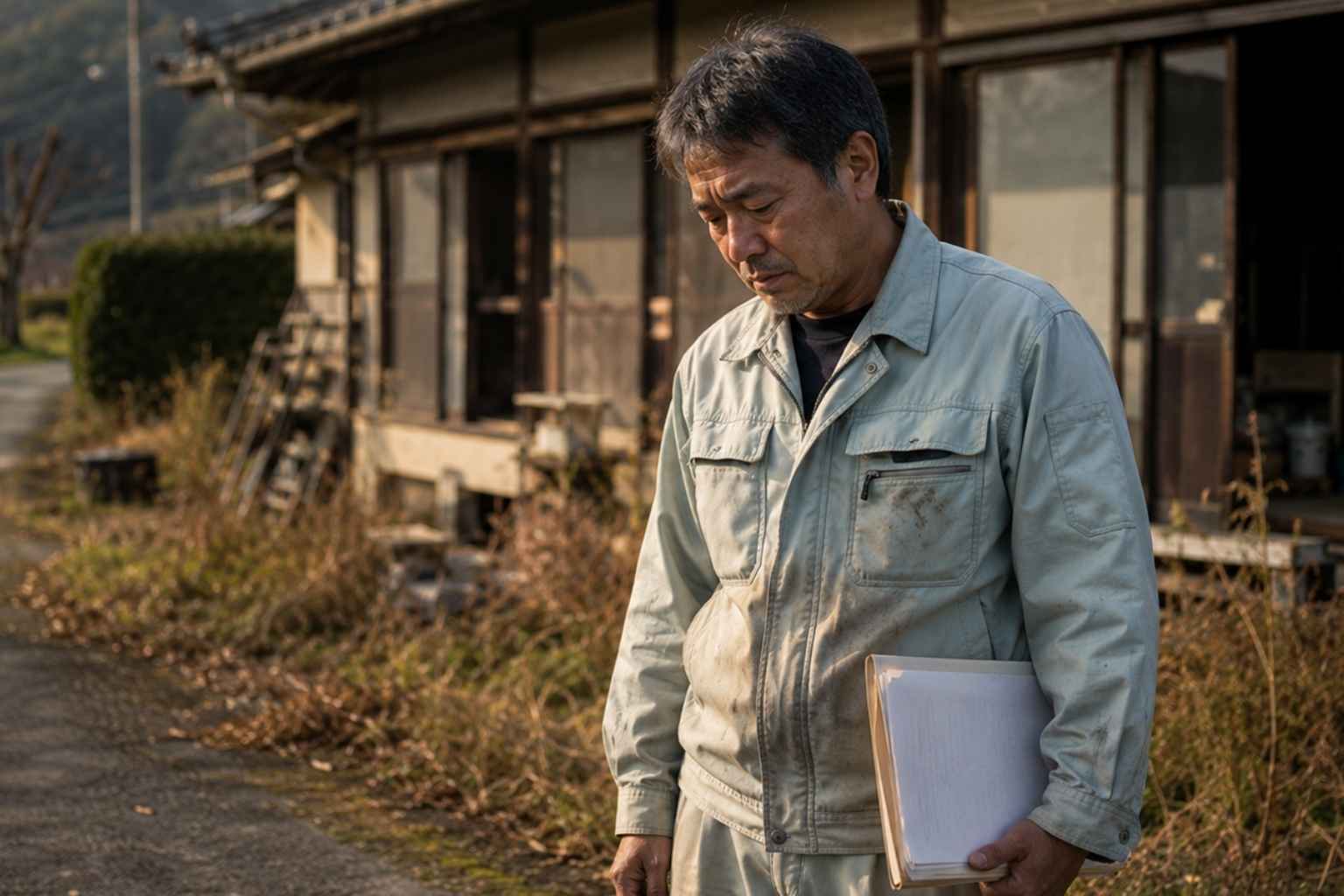
A 38-year-old construction worker in Tokyo gave away his childhood home for zero yen.
This story will resonate with anyone who has watched family roots lose value while city life becomes harder to afford.
It matters because Japan’s akiya crisis is not only about abandoned houses — it is about what happens when “home” becomes too expensive to keep alive.
The house was not sold.
It was given away.
His father spent 35 years paying off the mortgage on that home. A whole working life went into it. Years of payments, repairs, family memories, ordinary meals, quiet mornings, and the kind of history that does not show up on a property listing.
Now the modern economy says it is worth nothing.
Why This Story Hits Hard
That is the cruel part of Japan’s akiya crisis.
Across the countryside, millions of abandoned homes sit in towns that once held families, children, shops, neighbors, and routines. At the same time, luxury high-rises in Tokyo sell for prices ordinary families will never reach.
The media calls it an urban boom.
A real estate renaissance.
But there is another side to that story.
The places filled with actual memories, family history, and human life are now treated like financial garbage. A house that once represented stability can become a burden. A family inheritance can become a tax problem. A childhood home can become something nobody can afford to keep, even when nobody wants to lose it.
That is not just a housing issue.
It is an emotional collapse.
The Expectation vs Reality Shift
The old expectation was simple: your parents worked hard, paid off a home, and one day that home remained part of the family.
It was not just an asset. It was proof that someone endured.
But the reality now feels colder.
Young people are pushed into tiny city apartments that consume huge parts of their income, while the towns that raised them slowly fall silent. The homes are still standing. The roads are still there. The mountains are still there. But the future has moved away.
That is the gap that makes this story painful.
Tokyo can feel full of money, glass, towers, and movement. Rural Japan can feel full of empty rooms, closed shutters, and houses nobody knows what to do with anymore.
One place becomes too expensive to enter.
The other becomes too expensive to keep.
[Why Foreigners Get Rejected for Apartments in Japan]
What Changed Mentally
The 38-year-old worker said he never wanted to let go of his family home.
That detail matters.
This was not a simple decision about profit. It was not someone casually walking away from old property. It was a person being forced to release something that carried family meaning because the numbers no longer made sense.
The taxes were still real.
The maintenance was still real.
The emotional weight was still real.
But the market value was gone.
That is what changes people mentally. They start to understand that a home can be precious to a family and worthless to the economy at the same time.
That contradiction is brutal.
It makes people question what “value” even means. If a house carries 35 years of sacrifice but cannot be sold, does that mean the sacrifice has no value? If a town raised generations of families but has no buyers left, does that mean the town failed?
Or does it mean the system moved on without them?
The Hardest Lesson
The hardest lesson is that home is no longer protected by memory.
You can love a place and still be unable to keep it. You can inherit a house and still feel trapped by it. You can know every corner of a childhood home and still have to hand it to someone else for nothing.
That is why the Japan akiya crisis feels so much bigger than abandoned houses.
It exposes a deeper problem: modern life rewards concentration. People, jobs, money, transport, and opportunity keep gathering inside a few overcrowded mega-cities.
New York.
London.
Milan.
Toronto.
Tokyo.
Different countries, same pressure.
Regional towns everywhere are dying because wealth keeps concentrating in places already too expensive for ordinary people. We abandoned space, roots, and inheritance for the privilege of renting shoeboxes near train stations.
That sentence sounds harsh because it is true.
What Living in Japan Revealed
Japan reveals this contradiction clearly.
There are homes people can get for almost nothing, but not always the jobs, services, or future that make life there possible. There are cities full of opportunity, but not enough affordable space for the people chasing it.
So families get squeezed from both sides.
The countryside has the space but not the economy.
The city has the economy but not the space.
And somewhere in between, a person stands outside the home their father spent 35 years paying for, holding documents that turn a family story into a disposal problem.
That is the part people feel in their chest.
Because this is not only about Japan. It is about a modern world where roots are becoming expensive, space is becoming a luxury, and inheritance is not always a gift anymore.
[After 10 Years in Japan, I Stopped Trying to Belong]
What I Understand Now
I understand why people get angry when they hear about free houses in Japan.
At first, it sounds like a dream. A house for zero yen. A chance to escape rent. A way to own something in a country where city life feels impossible for many families.
But the deeper story is not romantic.
A free house can also mean a town losing its future. It can mean a family line letting go of its physical memory. It can mean a son or daughter realizing they cannot afford to preserve what their parents spent decades building.
That is not free.
Someone already paid for it.
They paid with work, time, stress, mortgage payments, repairs, and years of hope that the home would continue to matter.
Final Thought
The akiya crisis is not only about empty buildings.
It is about the emotional price of a society where some places become too valuable to live in, while other places become too forgotten to save.
A childhood home should not become a burden just because the economy moved away from it.
But for many families, that is now the reality.
The painful question is no longer only “Who wants this house?”
It is: what happens to people when even home becomes too expensive to keep alive?
Question for readers: Would you keep a family home if it had no market value but carried your parents’ whole life inside it?