
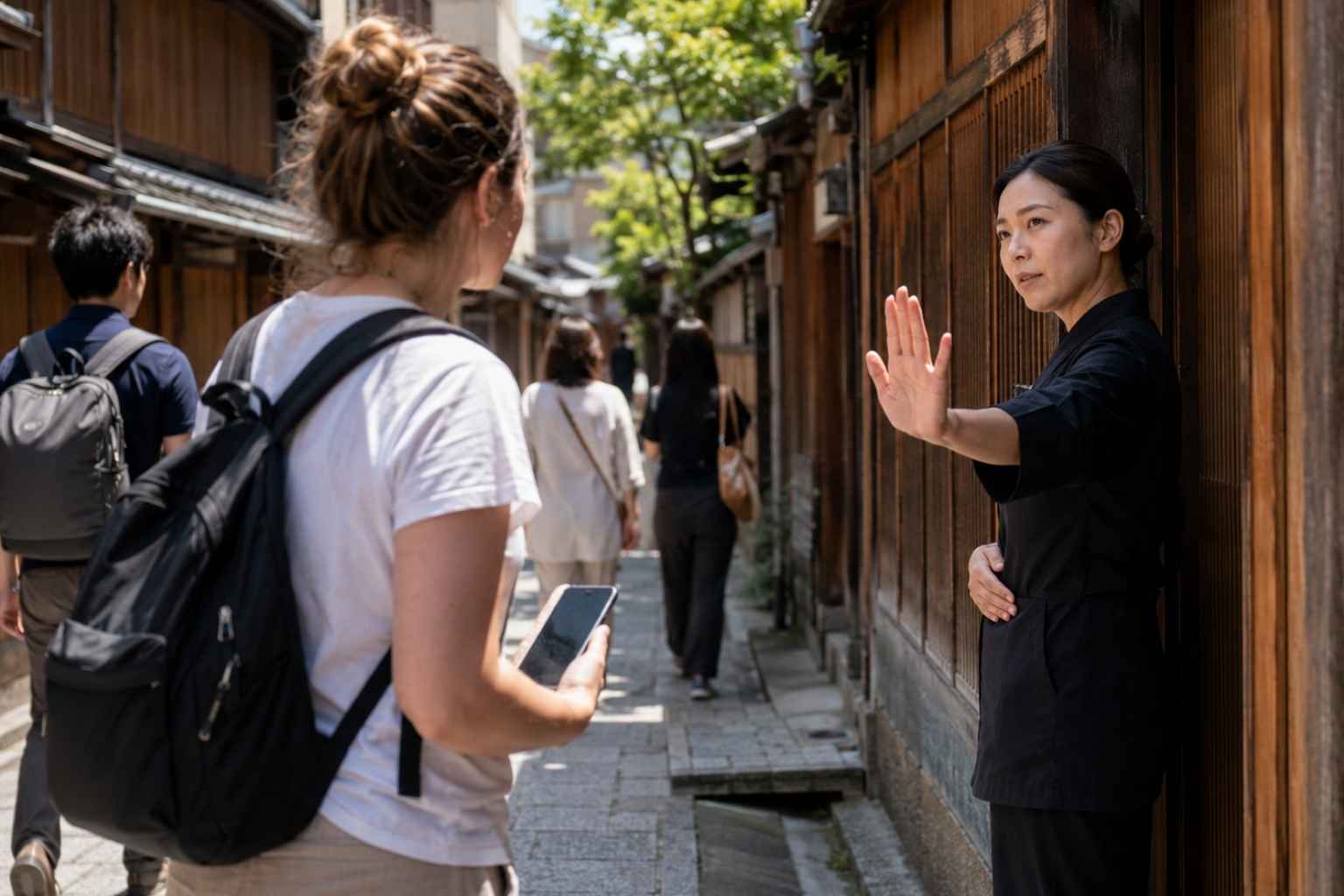
Gion is not a theme park.
One wrong photo can now turn a dream Kyoto walk into an awkward and expensive mistake.
The Kyoto Gion Photography Ban is not a blanket ban on every photo in Gion, but Kyoto’s official tourism guidance now warns visitors against unauthorized photos of geiko and maiko, photographing private property, entering private properties, and blocking streets. This affects tourists visiting Southern Gion, Hanamikoji, narrow side lanes, and other historic areas where residents, teahouses, restaurants, and working geiko and maiko share the same streets. It matters now because Gion’s private alleys and photography rules have become a major overtourism flashpoint, with reported keep-out signs and ¥10,000 fines on some private roads while Kyoto’s own guidance says violations may result in fines.
The safest rule is simple: do not treat Gion like an open photo set. Public streets may still be open for ordinary sightseeing, but private roads, private property, and geiko or maiko on their way to work require much more caution than many first-time visitors expect.
What Happened
Kyoto’s official 2026 sightseeing guidelines say that in Southern Gion and similar areas, problems have included following geiko and maiko, taking their photographs without permission, trespassing, and photographing private property. The same guidance asks visitors not to touch, chase, or photograph geiko and maiko without permission, not to enter private properties, and not to block streets or walk in large groups that obstruct traffic.
The stricter atmosphere follows years of complaints about tourists chasing geiko and maiko, crowding narrow lanes, entering private property, and ignoring local warnings. AP reported that Gion moved to close off several blocks of private-property alleys, with signs warning tourists to stay out of private roads and mentioning a ¥10,000 fine, while public streets in the district remained open.
That distinction is important. The issue is not that tourists can no longer visit Gion. The issue is that some parts of Gion are residential or private working spaces, and visitors who cross those boundaries may face warnings, police involvement, fines, or direct pushback from the local community.
Kyoto Gion Photography Ban: Who This Affects
This mainly affects travelers who arrive in Gion hoping to photograph traditional streets, teahouses, maiko, geiko, lanterns, and narrow alleys without understanding which spaces are public and which are not. It also affects visitors who follow other tourists into side streets or copy people taking photos near private entrances.
You should pay extra attention if you are:
- walking around Southern Gion or Hanamikoji
- trying to photograph geiko or maiko
- entering narrow side lanes that may be private
- stopping in the road to frame a shot
- using a tripod, selfie stick, or large camera setup
- photographing tea shops, private doorways, or residential areas
- following tour groups into tight streets
- assuming “other people are doing it” means it is allowed
Kyoto’s official Gion area page says taking pictures of maiko without permission is strictly prohibited, and it also warns that Hanamikoji has heavy traffic, so visitors should avoid walking in the middle of the road. That means the problem is not only the photo itself — it is also how the photo disrupts movement, privacy, and local work.
Why This Matters for Travelers
For visitors, Gion can look like the perfect Kyoto photo spot. For locals, it is a living district where residents, businesses, geiko, maiko, clients, delivery workers, and tourists are all squeezed into the same narrow streets.
That clash is why the Kyoto Gion Photography Ban matters as a travel rule, not just a photography warning. A tourist may think they are taking one harmless picture, while the person being photographed may be rushing to work, protecting a client’s privacy, or simply trying to move through their own neighborhood without being treated like a prop.
Kyoto’s Southern Gionmachi guidance says residents may report nuisance behavior and police officers may be called to the scene. It specifically tells visitors not to stop, touch, follow, or take unauthorized photos or videos of geiko and maiko, and it notes that obstructing someone’s path or stalking can carry penalties under law.
The same guidance warns visitors not to enter nearby temples, shrines, or private property without permission and not to damage property. It notes that trespassing and property damage can carry serious legal penalties, while blocking roads or sidewalks by stopping for photos can also create traffic problems for residents.
This is where many tourists misread the situation. A quiet warning, a staff gesture, a sign, or a local person staring is not just “Japanese politeness.” In Gion, it may be the final soft signal before the situation becomes more formal.
[Cheap Japan Is Getting Harder to Find in 2026]
What To Know Before You Go
The best way to avoid trouble is to treat Gion as a working cultural neighborhood first and a sightseeing area second. You can still enjoy the atmosphere, architecture, and public streets, but the rules are stricter when the camera comes out.
Before taking photos in Gion, follow these rules:
- Do not photograph geiko or maiko without permission.
- Do not stop, follow, chase, touch, or block geiko or maiko.
- Do not enter private roads, private alleys, private pathways, or private property.
- Do not photograph private property when local rules or signs prohibit it.
- Do not block narrow streets, sidewalks, entrances, or roadways for photos.
- Do not lean on lanterns, fences, wooden facades, or traditional building features.
- Do not use tripods in ways that obstruct traffic or pedestrians.
- Check signs carefully before taking out your phone or camera.
- If staff, residents, or guides tell you to stop, stop immediately.
Kyoto’s own travel guidance also says some shrines and temples have no-photo areas or flash restrictions, and visitors should check signs carefully. In Gion specifically, Kyoto says stopping maiko in the street or taking photos without permission is prohibited and that posting photos of specific people without permission can violate portrait rights.
A useful practical rule is this: if the lane is narrow, quiet, residential-looking, or marked by local warnings, do not enter for a photo. If you see a maiko or geiko, do not run after them, block them, call out loudly, or hold your phone close to their face.
Official Note
According to Kyoto’s official tourism guidance, visitors in Gion should not touch, chase, or take photos of geiko or maiko without permission, enter private properties, block streets, or photograph private property where prohibited. AP reported that some private-property alleys in Gion were closed off with signs warning of a ¥10,000 fine, while public streets remain open to tourists. Travelers should follow posted signs and local instructions on the day they visit, because specific boundaries and enforcement can vary by street.
[Why Some Japan Restaurants Quietly Turn Tourists Away]
Kyoto is still one of Japan’s most rewarding cities to visit, but Gion now demands a different mindset from tourists. The best memory may not be the photo you forced — it may be the moment you respected the place enough not to take one.
Question for readers: Are photography bans and cash fines fair ways to protect Gion, or do they make Kyoto feel less welcoming to tourists?