
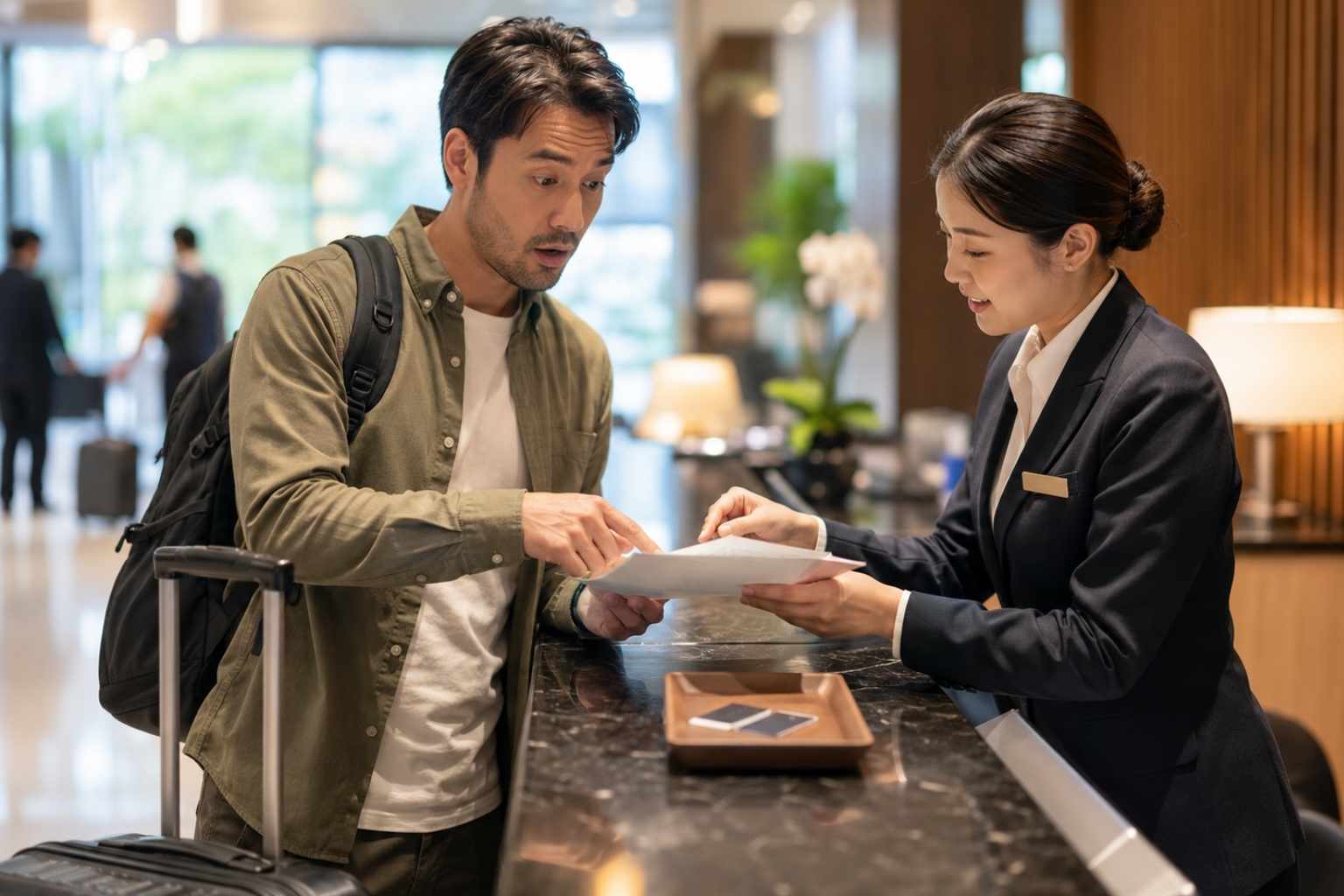
Your final hotel bill in Japan’s biggest tourist cities can be higher than the price you thought you booked. That affects tourists, business travelers, families, and anyone staying overnight in Tokyo, Osaka, or Kyoto. It matters now because japan hotel accommodation tax rates differ by city, are charged per person per night, and are often collected separately by the hotel at check-in or check-out.
That extra charge is not usually a hotel mistake. It is a local accommodation tax set by city or prefectural authorities and used to support tourism infrastructure, destination management, and related public services.
What Happened
The reason this issue keeps catching people off guard is simple. Many booking platforms show the room price first, while local lodging taxes may be added later by the hotel depending on the city and booking channel. That means travelers often arrive thinking they have already paid everything, only to discover a city tax at the desk.
In all three major destinations, the tax is tied to the accommodation charge, not the traveler’s nationality. It is generally calculated per person, per night, and based on the room-only lodging fee rather than meals or unrelated extras. Kyoto’s official city page states this clearly, and Tokyo and Osaka materials describe similar room-charge-based systems.
Tokyo still uses the familiar fixed-fee tier system. Official Tokyo tourism materials say stays under ¥10,000 per person per night are exempt, stays from ¥10,000 to under ¥15,000 are charged ¥100, and stays of ¥15,000 or more are charged ¥200.
Osaka is now more aggressive than before. Osaka Prefecture says that from September 1, 2025, the taxable threshold was lowered and the rates became ¥200 for stays from ¥5,000 to under ¥15,000, ¥400 for stays from ¥15,000 to under ¥20,000, and ¥500 for stays of ¥20,000 or more.
Kyoto changed its own system from March 2026. Kyoto City and Kyoto’s tourism office say the city now taxes every overnight stay, starting at ¥200 for under ¥6,000, then ¥400 for ¥6,000 to ¥19,999, ¥1,000 for ¥20,000 to ¥49,999, ¥4,000 for ¥50,000 to ¥99,999, and ¥10,000 for stays of ¥100,000 or more.
That makes Kyoto the hardest place to treat as a simple “small extra fee” issue. Budget stays are taxed there too, and high-end travelers can face a very visible jump on the final bill.
Who Is Affected
The most obvious impact falls on foreign tourists because many are comparing online rates across cities and assuming the headline booking price is the final number. A solo traveler might barely notice the tax, but couples, families, and group travelers pay it per person, per night, so the total grows quickly.
Business travelers are affected too, especially those moving between Tokyo, Osaka, and Kyoto on one trip. A traveler staying in multiple cities may assume hotel pricing works the same everywhere, but the tax structure changes from city to city.
Budget travelers feel the surprise differently depending on where they stay. In Tokyo, low-cost stays under ¥10,000 are still exempt under the current system. In Osaka, taxation now begins at ¥5,000. In Kyoto, there is no low-price exemption at all under the current 2026 structure.
That means the same traveler can book three similarly priced rooms in three different cities and get three different tax outcomes. This is one reason japan hotel accommodation tax rates keep confusing visitors who assume Japan uses a single national hotel tax rule.
Why This Matters
This matters because the tax is small enough to be ignored in marketing, but real enough to disrupt travel budgets. For travelers already calculating rail passes, attraction fees, restaurant spending, and exchange rates closely, even a few hundred yen per person per night changes the total at the end of a trip.
It also matters because local governments are adjusting these systems as tourism pressure grows. Osaka already tightened its structure in 2025, and Kyoto raised its accommodation tax from March 2026. Tokyo, meanwhile, has discussed a possible future shift from fixed amounts to a 3% rate, but reporting in late 2025 described that as a plan rather than an already implemented system.
So the issue is not static. Travelers who rely on outdated blog posts or old booking assumptions can easily arrive with the wrong number in mind. That is especially true in Kyoto, where the 2026 tier changes made the gap between cheaper and luxury accommodation tax far wider.
[Japan Tightens Pressure on Foreign Students Working Over the Limit]
What To Know Now
The safest approach is to assume the listed room rate may not be the full on-site total. Travelers should check whether local taxes are included in the booking confirmation and, if not, estimate the city charge in advance using the nightly room-only price per guest.
It also helps to know the current city rules before booking:
- Tokyo: under ¥10,000 exempt; ¥10,000 to under ¥15,000 is ¥100; ¥15,000 or more is ¥200.
- Osaka: ¥5,000 to under ¥15,000 is ¥200; ¥15,000 to under ¥20,000 is ¥400; ¥20,000 or more is ¥500.
- Kyoto: under ¥6,000 is ¥200; ¥6,000 to ¥19,999 is ¥400; ¥20,000 to ¥49,999 is ¥1,000; ¥50,000 to ¥99,999 is ¥4,000; ¥100,000 or more is ¥10,000.
Travelers should also avoid assuming all properties handle payment the same way. Large hotels usually process these charges easily by card, but smaller accommodations may still expect immediate local payment at reception. The main point is not that the tax is hidden by law, but that it is often not the number travelers focus on when they make the booking.
Official Note
According to official Tokyo tourism materials, Tokyo still uses the long-standing fixed accommodation tax tiers of exempt under ¥10,000, then ¥100 and ¥200 depending on the nightly room charge. Osaka Prefecture says its updated system has applied since September 1, 2025, and Kyoto’s tourism office and city government say Kyoto’s revised structure began in March 2026.
[Japan’s Egg Freezing Subsidy Cuts Off Unmarried Women Over 35]
That extra line on the hotel bill is usually not random. It is the local tax system finally showing up at the moment travelers expected the booking price to stay simple.
Question for readers: Have you ever been surprised by unexpected taxes or fees when checking out of a hotel in Japan?