
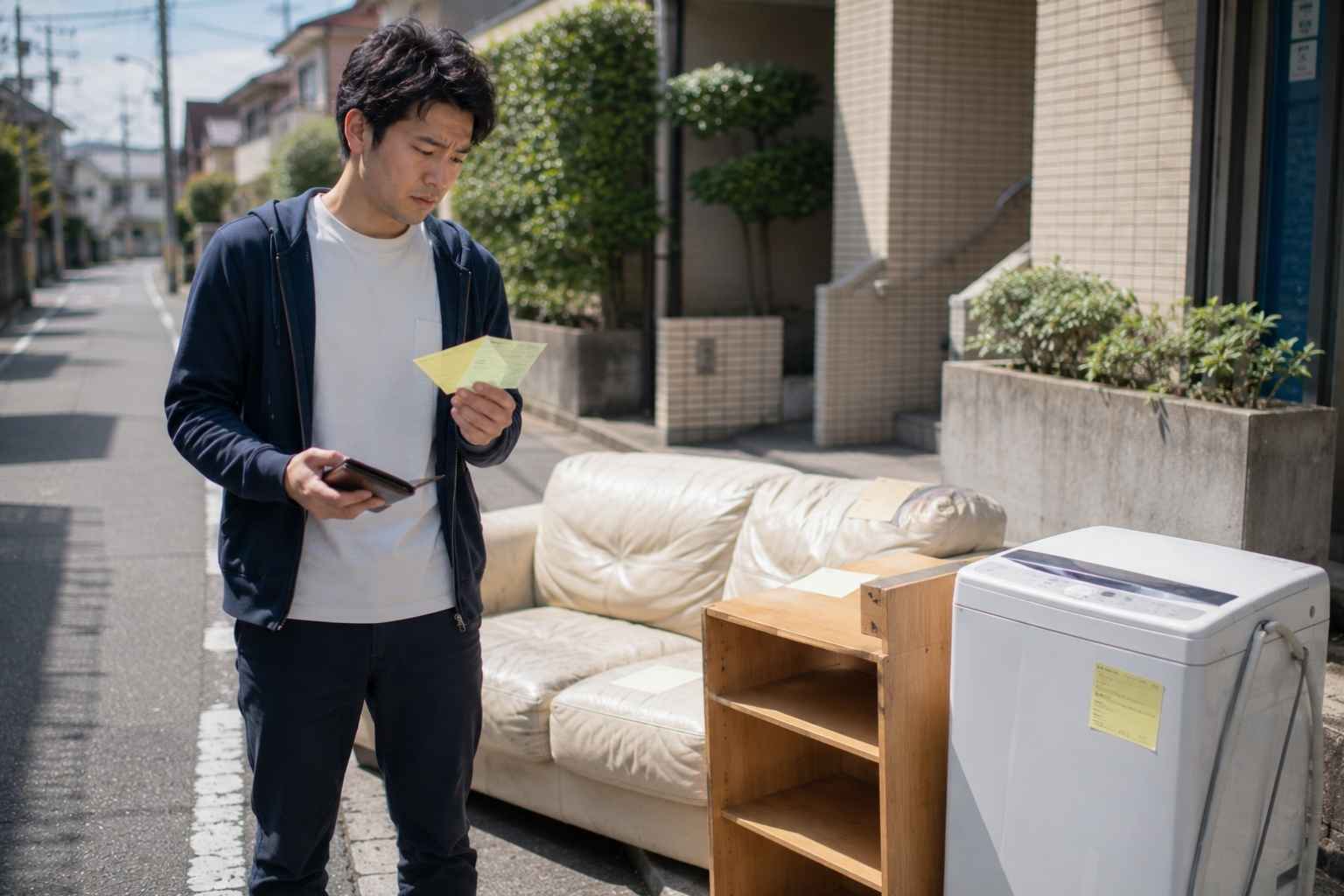
A practical guide to large-item disposal, disposal stickers, recycling fees, and safer ways to get rid of unwanted furniture and electronics in Japan.
For newcomers, students moving apartments, and residents doing a deep clean who do not want one old couch to turn into an expensive mistake.
This guide covers how to throw away large items in Japan without getting fined, why leaving old furniture on the street can backfire fast, and what disposal options matter most before moving day or a major cleanup. It is for newcomers, students, families, and long-term residents who suddenly need to get rid of bulky junk the right way. It matters now because the hidden cost of throwing things away in Japan catches people exactly when they are already stressed, busy, and trying to save money.
This is where people get blindsided. You think the expensive part was buying the couch, the TV, or the washing machine. Then you find out that getting rid of it can become its own bill, its own errand, and its own social risk.
That is why this topic gets saved. The mistake is easy to make, the rules feel stricter than many people expect, and one lazy decision can turn a simple cleanup into a fine, a neighborhood problem, or both.
Why This Guide Matters
Japan’s disposal system feels harsh to people who are new to it because the obvious shortcut is not really a shortcut. You cannot simply leave old furniture or electronics on the street and assume it will disappear. That is the exact misunderstanding that creates the hidden junk tax.
The cost is not only money. It is also timing, effort, and the pressure of getting it wrong in a residential area where people notice fast. One bad disposal choice can suddenly become public, embarrassing, and expensive.
This issue hits hardest during the moments when people already feel squeezed. Moving out of an apartment, replacing broken furniture, downsizing, or doing a full cleanout sounds productive until the disposal part shows up. Then the hidden question appears: what exactly are you supposed to do with all this stuff?
That is where Japan feels different. The clean streets are real, but they stay clean partly because people are not allowed to dump bulky junk wherever they want. The system expects you to sort, prepare, and in some cases pay before the item leaves your life.
That is also why the couch example works so well. A big old sofa feels worthless when you want it gone. But in Japan, worthless does not always mean free to throw away. That gap between “I don’t need this” and “I still have to handle this properly” is what surprises people most.
The biggest emotional mistake is thinking the hard part is over once you decide to get rid of something. In many cases, the hard part starts there. A cheap old item can still become a costly disposal problem if you approach it casually.
What This Is and Who Needs It
This is a practical living-in-Japan guide for bulky trash, unwanted furniture, and old electronics that cannot simply be abandoned outside. It is not a full city-by-city garbage manual. It is a survival guide built around the key facts that prevent the most expensive mistakes.
This guide is especially useful if you are:
- moving apartments and suddenly need to clear out large items fast
- a student or newcomer furnishing a place cheaply and now dealing with old junk
- replacing broken electronics and unsure what the old ones will cost to remove
- doing a deep clean and realizing the disposal step is harder than the cleanup itself
- tempted to leave something outside “just for a little while”
It also matters for people who are trying to save money. The raw details make that tension clear. The disposal system can punish the exact person who thought they were making the cheap choice.
That is why the phrase “hidden junk tax” works. It is not always a formal tax, but it feels like one. You already paid for the item once, and now you are paying again just to make it disappear legally.
This guide also helps people who are trying to avoid social damage, not just fines. Illegal dumping in residential areas is not only risky because of money. It can also create neighborhood trouble, unwanted attention, and the feeling that one rushed decision made you look irresponsible in a place where people are watching the shared space closely.
That combination makes the topic bigger than trash. It becomes a daily-life systems issue, which is exactly why it belongs in a Living in Japan guide.
Costs, Documents, or Setup Steps
The most important starting point is simple: large items and certain electronics are not “normal trash” you can just drop on the street. That rule alone prevents the most expensive beginner mistake.
From there, the disposal path splits into two main categories based on your raw details.
1) Large Household Items and Furniture
For bulky items, the core detail you need is the Sodai Gomi disposal sticker. These stickers can be bought at local convenience stores.
That matters because the disposal process is not only about getting rid of an item. It is about showing that the item has been handled through the proper paid system. The sticker is part of that logic.
A practical setup for bulky items looks like this:
- Identify the item you want to get rid of
- Treat it as a disposal task, not a casual trash drop
- Buy the required Sodai Gomi sticker at a local convenience store
- Do not assume that “putting it outside” counts as proper disposal
The biggest benefit of understanding this early is time. The later you learn it, the more likely you are to be dealing with a move deadline, a landlord schedule, or a room full of things you thought would be easy to remove.
2) Electronics Covered by Recycling Fees
The second category is where many people get hit harder than expected. According to your raw details, AC units, TVs, and washing machines fall under recycling-law disposal fees.
The fee range you gave is the critical point: ¥1,500 to ¥6,000.
That changes the emotional tone immediately. Once people hear “recycling law,” they stop thinking in terms of ordinary trash and start realizing this is a separate cost structure. The item is no longer just junk. It is a disposal expense.
A practical way to think about these appliances is this:
- They are not throwaway street items
- They can trigger an extra recycling fee
- The fee can range from ¥1,500 to ¥6,000
- The cost is high enough that it should be part of your move-out or cleanup budget
This is where many people make the worst choice. They delay. They hope the issue will solve itself. Then the clock runs out and the temptation to dump something illegally starts looking easier than it should.
That is exactly the moment this guide is trying to stop.
Common Mistakes and Practical Tips
The first big mistake is assuming that if an item is old, ugly, or nearly broken, it has become “free to dump.” In Japan, that logic can cost you. Age and low value do not erase disposal rules.
The second common mistake is ignoring alternatives that could help you avoid disposal fees entirely. Your raw details point to two important escape routes: Mottainai Facebook groups and Mercari.
That matters because not every unwanted item has to become a paid disposal event. Sometimes the cheapest move is not throwing something away at all.
A smarter approach is:
- Check whether the item can be passed on through a Mottainai Facebook group
- Check whether it can be sold or moved through Mercari
- Use those options to avoid disposal fees when possible
This is especially useful for furniture that still has life left in it. The item may be useless to you, but not useless to someone else.
Another major mistake is underestimating illegal dumping. Your raw details are clear on this point: the consequences can be severe. The problem is not only the possibility of massive fines. It is also the neighborhood effect.
Illegal dumping in residential areas creates two layers of damage:
- financial risk
- social consequences
That second part matters more than many newcomers expect. Even when people focus only on the money, the bigger stress may come from the fact that residential dumping turns a private mistake into a public one.
A few practical tips can save you a lot of trouble:
- Do not leave large items outside and hope no one notices
- Do not wait until the last days of a move to think about disposal
- Do not assume electronics follow the same rules as ordinary furniture
- Do treat convenience-store Sodai Gomi stickers as part of the process, not an optional extra
- Do check reuse options before paying to dispose of something
The hidden win here is not only avoiding fines. It is avoiding panic. Once your cleanup plan includes disposal from the start, the whole process becomes less chaotic.
What To Do Next
If you are staring at an old couch, shelf, washing machine, or TV right now, do not treat that item like tomorrow’s problem. In Japan, disposal mistakes get more expensive the longer you avoid them.
Start with a simple decision tree.
If it is a large household item:
Plan around Sodai Gomi and buy the sticker at a local convenience store.
If it is an AC unit, TV, or washing machine:
Expect recycling-law fees in the ¥1,500 to ¥6,000 range.
If the item still has value or use:
Check Mottainai Facebook groups or Mercari before paying to dispose of it.
That one shift in thinking can save real money. The cheapest disposal is often not disposal at all. If someone else can take the item, you may avoid the fee and the hassle.
This is also the moment to get honest about timing. Deep cleans and moves go badly when disposal becomes the last task instead of one of the first. The larger the item, the earlier it should be on your list.
A strong next-step checklist looks like this:
- Separate bulky furniture from normal trash in your mind immediately
- Identify whether the item is a standard large-item case or an electronics recycling-fee case
- Buy Sodai Gomi stickers at a local convenience store for large-item disposal
- Budget for ¥1,500–¥6,000 if the item is an AC unit, TV, or washing machine
- Check Mottainai Facebook groups and Mercari before paying disposal fees
- Avoid illegal dumping completely
The hidden lesson in all of this is simple. Throwing something away in Japan is not always about trash. It is often about paperwork, payment, timing, and shared-space responsibility.
Official Note
This guide is based on the disposal rules and cost points listed above: large items cannot simply be left on the street, Sodai Gomi stickers can be bought at local convenience stores, AC units, TVs, and washing machines can trigger recycling-law fees of ¥1,500 to ¥6,000, reuse options such as Mottainai Facebook groups and Mercari can help avoid fees, and illegal dumping in residential areas can bring major fines and social consequences.
The most expensive trash mistake in Japan is usually not buying too much. It is assuming getting rid of it will be easy.
Question for readers: What shocked you more in Japan: the disposal fee itself, the recycling rules, or how risky illegal dumping can become in a residential area?