
A personal reflection on what living in Japan revealed when the fantasy of starting over wore off.
For anyone who has moved abroad hoping distance would heal what they never faced.
This is a story about what living in Japan revealed when I stopped treating a move like a cure. It will resonate with anyone who has moved abroad hoping a new country would quiet burnout, loneliness, or the version of themselves they wanted to leave behind. It matters because changing locations can change your surroundings, but it cannot do the deeper work for you.
When I moved to Japan, I thought I was starting over. New country. New life. New version of myself.
I believed the lights of Tokyo and the calm of temples would fix what I was feeling: burnout, restlessness, and that constant noise in my head. I thought distance would create clarity.
But when I got here, nothing really changed.
Because I brought everything with me.
Why This Story Hits Hard
That was the shock. Not that Japan disappointed me, but that it stripped away my excuses.
Back home, I knew how to be someone. I knew how to joke, how to speak, how to belong. Even when I was struggling, I still had the muscle memory of who I was supposed to be.
Here, I lost that.
Without language, without comfort, without home advantage, there was nowhere to hide. I felt quiet in a way I had never felt before. Awkward. Smaller than usual. Almost childlike.
It was like my personality got left at the airport.
That feeling can be hard to explain unless you have lived abroad long enough to realize that relocation does not just remove stress. It also removes the familiar identity you used to lean on without even noticing. The parts of you that once felt automatic suddenly do not work the same way.
And when those parts disappear, what is left can feel unsettling.
The Expectation vs Reality Shift
I came to Japan carrying an idea that a lot of people carry when they move somewhere new: the belief that place can solve what pain could not.
I did not think it in those exact words at the time. I just believed that if the environment changed enough, I would change with it.
I thought beauty would help. Order would help. Distance would help.
Instead, Japan gave me something else.
It gave me silence.
Not the romantic kind. Not the cinematic kind. The real kind. The kind that appears when distraction runs out and there is nothing left between you and your own mind.
That is when the fantasy cracked.
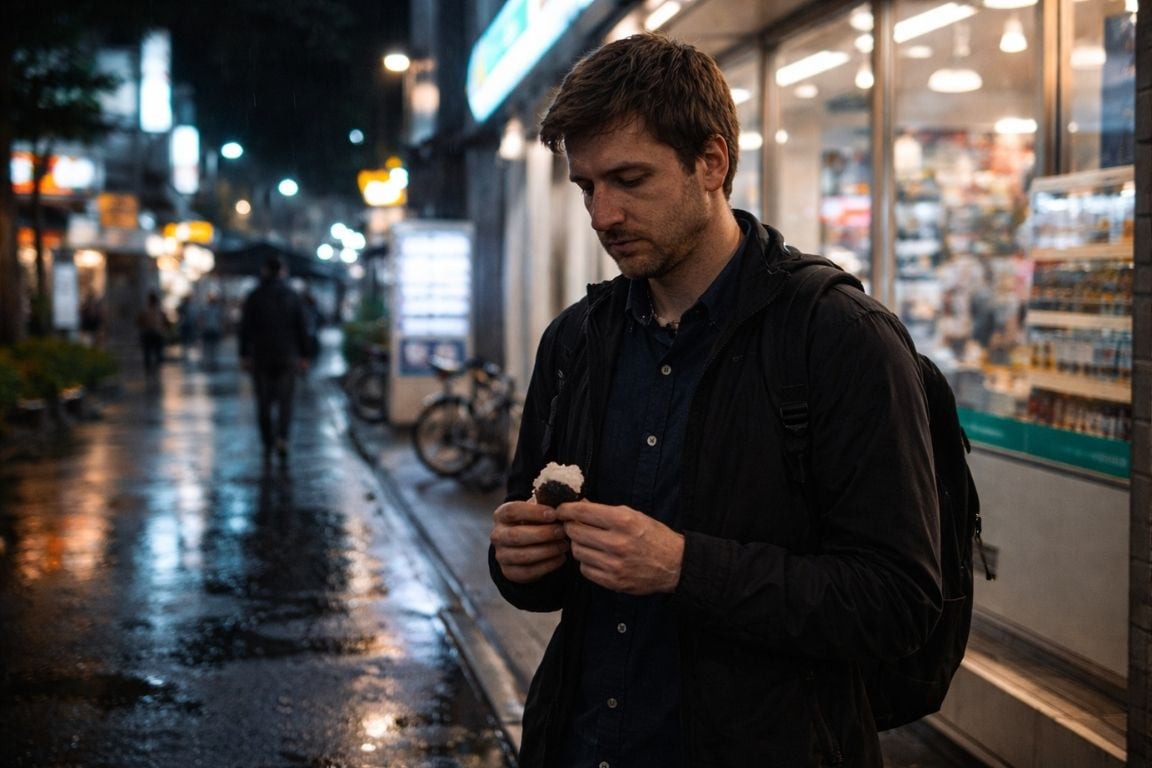
The real turning point did not happen at a shrine or during some life-changing travel moment. It happened at 11 PM, standing outside a convenience store in the rain, holding a cheap rice ball.
No noise. No performance. No escape.
Just me and my thoughts.
And for the first time, I stopped blaming everything else.
What Changed Mentally
That moment forced me to understand a few things I had been avoiding for a long time:
- A new place does not fix old habits.
- Losing your identity can reveal who you are without your usual defenses.
- Silence feels uncomfortable when it starts telling the truth.
- Real change begins when you stop escaping and start facing what is there.
That was harder than I expected because it meant giving up a very convenient story. It meant admitting that the problem was not only where I had been. It was also how I had been living inside myself.
That is not a dramatic statement. It is just an honest one.
The Hardest Lesson
The hardest lesson was this: you can move anywhere in the world, but you cannot outrun yourself.
That sentence sounds simple until you live it.
It means the burnout travels with you if you do not understand it. The loneliness travels with you if you expect a place to do the work of connection. The restlessness travels with you if movement itself has become your coping mechanism.
Japan did not create those things in me.
It exposed them.
That is why I no longer see this experience as a failed fresh start. It was something more useful than that, even if it was also more painful. It showed me the difference between external change and internal change.
Those are not the same thing.
What Living in Japan Revealed
Japan became a mirror.
Not because it is harsh, and not because it is cold, but because it removed enough noise for me to hear myself more clearly. The structure, the distance, the unfamiliarity, and the quiet all forced me to confront things I had spent a long time pushing aside.
I saw how much of my identity had depended on familiarity.
I saw how much of my confidence had depended on already knowing the rules.
I saw how quickly I confused movement with progress.
That does not make living here meaningless. It makes it honest.
For me, the value of living in Japan was never that it gave me a new life. It was that it stopped me from pretending I already had one figured out.
What I Understand Now
I am not trying to start over anymore.
That idea sounds clean, but it often hides something messier underneath. Sometimes “starting over” is really just another way of saying “I do not want to deal with what came before.”
What I want now is less dramatic and more real.
I want to understand myself wherever I am.
I want to stop treating geography like a solution.
I want to become someone who does not need a new backdrop to be honest.
That shift changed everything for me. Not all at once, and not in some perfect healing arc, but enough to make me stop looking at Japan as an escape hatch.
Now I see it as the place where I had to stop running.
Final Thought
Living in Japan did not save me. It made me face myself without the usual distractions, and that was far more uncomfortable than I expected.
But it was also the first thing that felt real.
If that sounds heavy, it is. But I think many people who move abroad know exactly what I mean. Sometimes the most important thing a new country gives you is not reinvention. It is confrontation.
And sometimes that is the beginning of something more honest than a fresh start ever could be.
Question for readers: If you left everything behind tomorrow, what do you think you would actually be trying to escape from?