
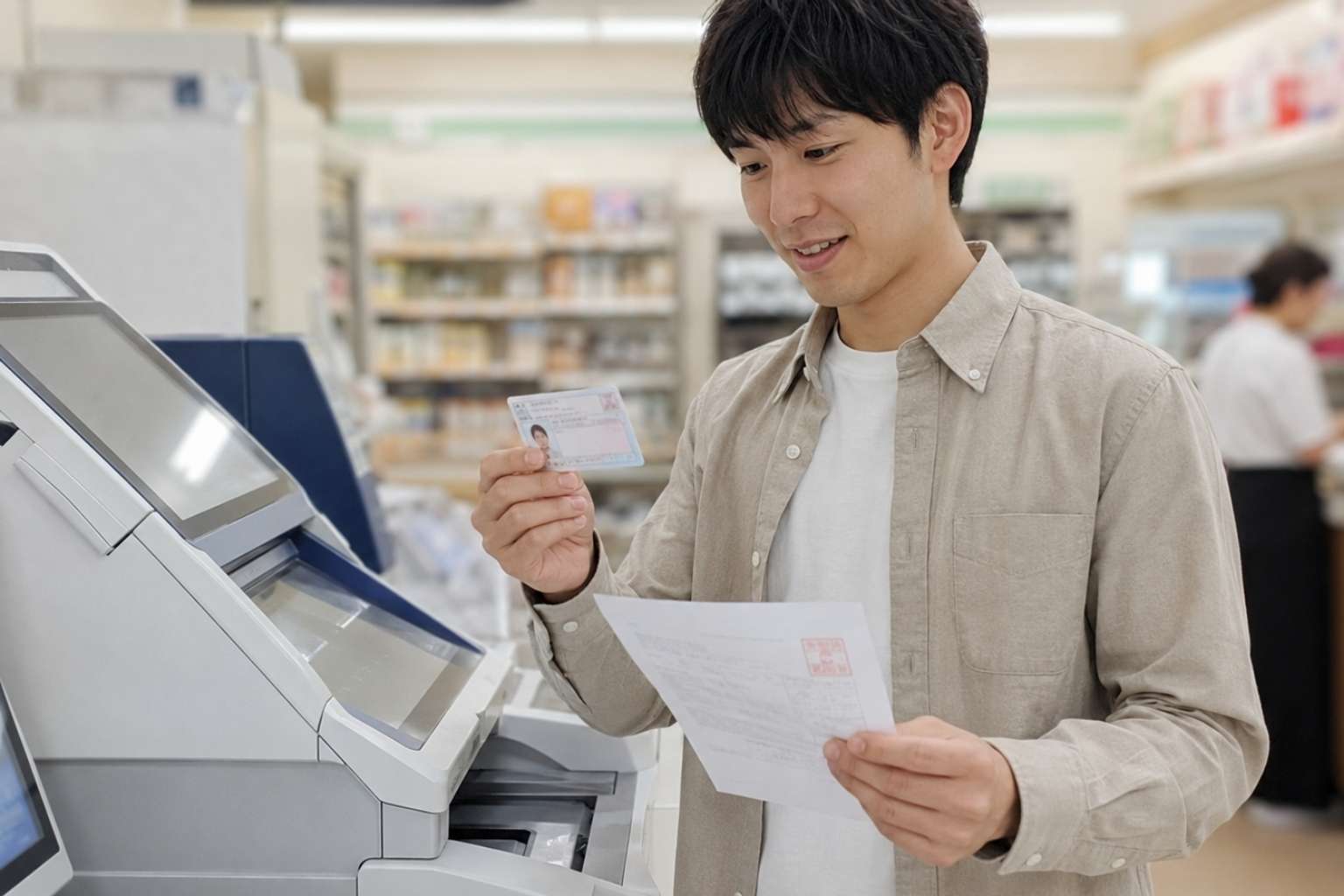
Skip the city office line and get your Certificate of Residence faster.
A practical Japan paperwork guide for foreign residents, apartment hunters, and anyone who needs a fresh Juminhyo fast.
This guide covers how to print a Juminhyo at a convenience store in Japan, who can use the service, and what you need before you walk up to the machine. It is for long-term expats, apartment hunters, workers, students, and anyone who needs a fresh Certificate of Residence without wasting half a day at city hall. It matters now because if your municipality offers convenience-store certificate issuance, you can often get the document early in the morning or late at night instead of waiting for limited office hours.
For many people in Japan, the hardest part of paperwork is not the document itself. It is taking time off work, guessing the right counter, and waiting in line for something that should take minutes. A Juminhyo is one of the most common documents people need during apartment hunting, job changes, and other official procedures, so learning the convenience-store route can remove one of the most annoying bureaucratic chores from daily life.
Why This Guide Matters
A Juminhyo is your resident record, and a fresh copy is often requested when another party needs proof of your registered address in Japan. That is why it keeps showing up during major life changes, especially when you are signing a lease, starting a new job, opening certain accounts, or handling other identity-heavy procedures. Using the convenience-store route matters because the document is often needed urgently, not on a day when the ward office happens to be convenient for you.
The convenience-store system exists precisely to reduce that friction. J-LIS says residents of participating municipalities can obtain copies of resident records and other certificates at convenience stores and similar kiosks instead of going to the municipal counter, and local government guidance shows the service is commonly available from early morning to late evening.
That shift is especially useful for foreign residents. Some city guidance specifically shows menu steps for foreign residents and notes that when the certificate includes only foreign residents, the screen flow changes to let you choose the relevant foreign-resident items. In other words, this is not a side feature built only for Japanese nationals. It is part of the normal resident-certificate system for registered residents in participating municipalities.
The practical value is simple. If you know the requirements and the steps, a document that used to feel like a half-day errand can become a five-minute stop on the way home.
What This Is and Who Needs It
This is a practical guide to printing a Juminhyo through Japan’s convenience-store certificate issuance service. It is not a full city-office manual and it is not a guide to every document type. It is focused on one task: getting a copy of your resident record quickly through a kiosk machine when your city supports it.
This guide is especially useful for:
- apartment hunters who need a fresh address certificate quickly
- foreign workers starting a new job or updating employer paperwork
- long-term residents handling routine official procedures
- students who do not want to lose a weekday to ward-office lines
- anyone who already has a My Number Card and wants to use it properly
The first thing to understand is that not every resident in Japan can automatically use the service. The My Number Card site says you can get a Juminhyo at a convenience store only if your municipality offers convenience-store issuance. That means the smartest first step is not going to the nearest machine blindly. It is checking whether your city participates.
The second thing to understand is that this is usually a My Number Card service, not a generic ID service. The standard requirement is a My Number Card with the user-certificate function and the 4-digit user certificate PIN. Some municipalities now also support smartphone electronic certificate use at certain kiosks, but you should not assume phone-only access unless your own city says it is supported.
That distinction matters because it is where a lot of last-minute frustration starts. People arrive at the machine with the wrong card, an expired electronic certificate, or a phone they assumed would work everywhere. Then the “fast” method becomes a failed trip.
Costs, Documents, or Setup Steps
The convenience-store route is fast only if you show up with the right things. In most cases, you need a My Number Card with the user certificate loaded, and you need the 4-digit PIN for that certificate. Official guidance also warns that if the electronic certificate has expired, convenience-store issuance will not work.
You should also know one timing catch before you depend on the service for something urgent. Yokohama’s official guidance says you cannot use convenience-store issuance on the same day you receive the My Number Card; service starts from the next day, and in some cases there may be an extra short delay before the system fully updates.
Here is the practical setup:
- Confirm your municipality offers convenience-store issuance.
- Bring your My Number Card.
- Know your 4-digit user certificate PIN.
- Go to a convenience store or other supported location with a multi-copy kiosk.
- Select the administrative certificate service on the screen.
- Scan or tap the card and enter the PIN.
- Choose Juminhyo and the print options you need.
- Pay the fee and collect the document and receipt.
The service is widely available at major chains with multi-copy machines. Yokohama’s published list includes Seven-Eleven, FamilyMart, Lawson, Lawson Three-F, Ministop, and AEON Retail locations with supported machines, and J-LIS describes the network as a nationwide convenience-store and kiosk service for participating municipalities.
Hours are one of the biggest advantages. Official local guidance shows a typical availability window of 6:30 a.m. to 11:00 p.m., excluding system outages, which is far more useful for most working residents than city-office counter hours.
The fee is the one part you should never guess. It is not fully standardized nationwide. Shinjuku says a copy is 200 yen, while Yokohama lists 250 yen, and Setagaya has even run seasonal discount campaigns that temporarily dropped some convenience-store certificate fees to 10 yen. That means you should check your own municipality’s current fee page before you go.
That fee difference is also why the convenience-store method can be more than just faster. In some cities it is not only easier than the ward office. It is also cheaper.
[The Frozen Account Trap in Japan: Why Legal Residents Get Locked Out During Visa Renewal]
Common Mistakes and Practical Tips
The most common mistake is assuming any My Number-related card or number will work. It will not. Official guidance is clear that this service is tied to the My Number Card and the user certificate PIN, not just your resident number or an older seal-registration card.
The next mistake is forgetting the PIN. The 4-digit PIN used here is the user-certificate PIN, and the My Number Card site says that if you forget it or lock it after repeated incorrect entries, you need a reset procedure through your municipality, though some reset routes can now use a smartphone plus kiosk when the other required password is known.
Another common mistake is expecting every version of the resident record to be available through the kiosk. Yokohama’s official page says some versions cannot be issued through convenience-store service, including records with a resident record code, removed records, and some cases requiring handwritten additions or involving pending movers in the household. If you need a special version, the ward office or mail request may still be necessary.
A stronger routine looks like this:
- check your city’s service page before you leave home
- confirm the fee first
- confirm whether your document type is actually available via kiosk
- bring the physical My Number Card unless your city clearly says smartphone certificates are accepted
- do not wait until the last hour before a lease signing or employer deadline
One more useful tip: if you are shopping for an apartment or handling time-sensitive paperwork, print the Juminhyo before you are asked for it. The document itself may be simple, but the timing pressure around it is what causes most stress.
What To Do Next
If you want to make this process easy from now on, do three things before you need the document in an emergency. First, confirm your municipality participates in convenience-store issuance. Second, make sure your My Number Card and electronic certificate are still usable. Third, remember or securely confirm your 4-digit PIN before the day you actually need the printout.
If you are using the service for the first time, choose a quiet time and test it before a real deadline. That removes the worst pressure. A first-time run on a calm day is much better than trying to figure out the kiosk while a real estate agent, employer, or bank deadline is already waiting.
If your city supports smartphone certificate use, you can also check whether that applies to your document and machine. But the safest all-purpose plan is still to carry the physical My Number Card until you have verified your municipality’s current rules yourself.
That is the real life hack here. The convenience-store method is not just about saving a trip. It is about turning one of the most repeated paperwork tasks in Japan into something predictable, fast, and under your control.
[Japan’s 2026 Visa Cost Shock: What Staying Really Costs Now]
Official Note
Convenience-store Juminhyo issuance is available only for residents of participating municipalities, typically requires a My Number Card with a valid user certificate and 4-digit PIN, and may exclude certain special record types or cases that still need counter or mail handling. Fees and smartphone support vary by municipality, so always check your own city’s latest page before relying on the service for an urgent application.
Once you learn the kiosk route, a Juminhyo stops being a bureaucratic chore and starts feeling like a quick errand you can handle on your own schedule.
Question for readers: Have you ever printed a Juminhyo at a convenience store in Japan, or do you still go to the city office every time?