
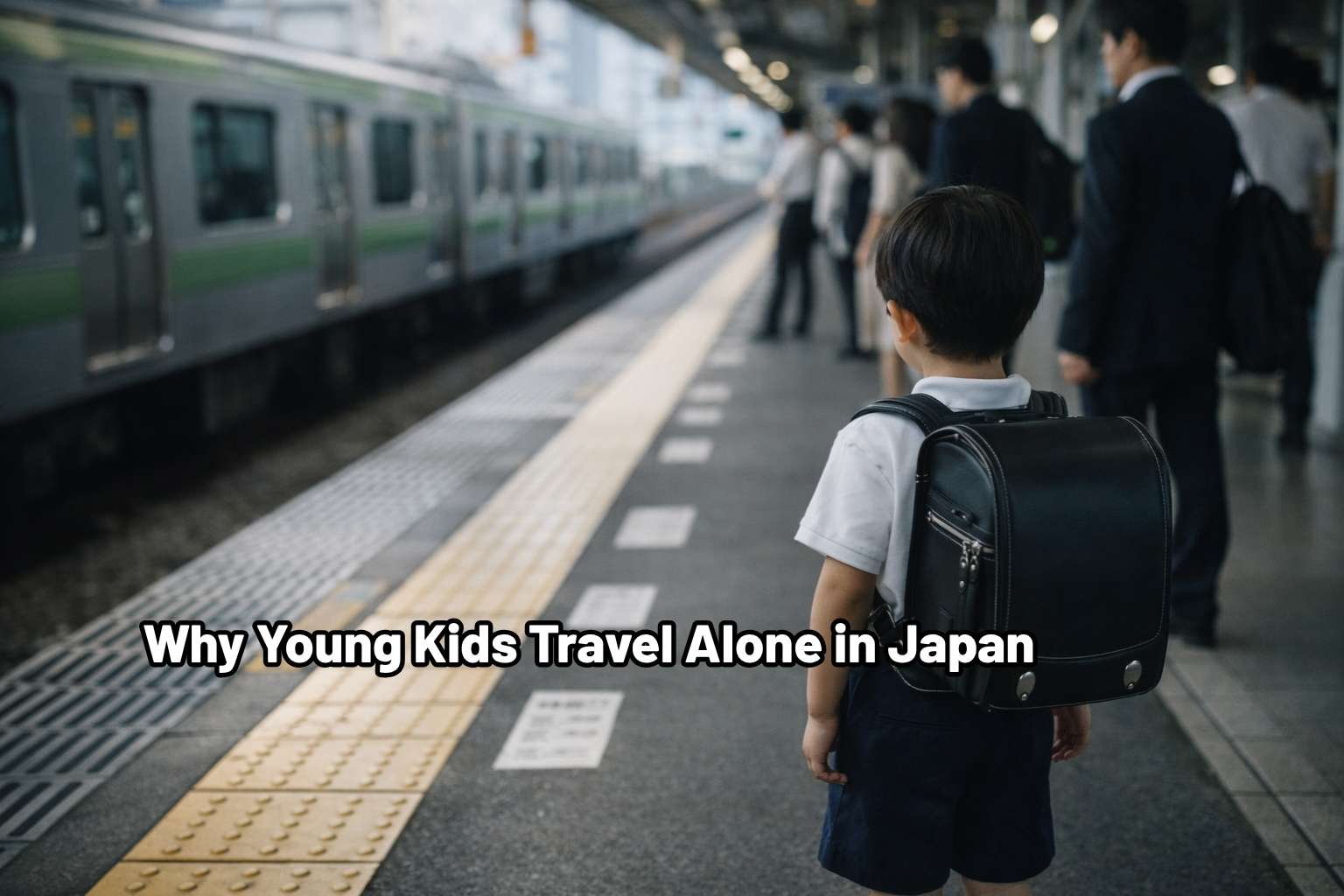
A closer look at why solo school commutes feel normal in Japan but alarming elsewhere.
The same scene can look like confidence, neglect, or a system working exactly as designed.
This article is about the shock many foreigners feel when they see young children commuting alone in Japan. It will resonate with parents, foreign residents, and anyone trying to understand why the same act looks normal here and alarming elsewhere. It matters because this debate is not just about parenting style. It is about safety, infrastructure, and what a society expects from itself.
A 6-year-old riding the train alone does not usually trigger panic in Japan. In many places outside Japan, that same sight can feel unthinkable.
That gap in reaction is what makes this story so powerful. One country sees early independence. Another sees risk.
Why This Story Hits Hard
For many people arriving in Japan, one of the most startling everyday scenes is not a festival, a shrine, or a futuristic train station. It is a very small child walking to school alone or standing on public transport without a parent in sight.
In Japan, young children commuting solo is presented as normal daily life. Elementary school children often walk or take trains alone, and the system around them is built with that expectation in mind.
The raw logic behind it is simple. There is no strict national minimum age for being outside alone, and the model depends on safe infrastructure and community awareness. Schools and routes are designed with child independence in mind.
That is why supporters do not describe this as recklessness. They describe it as structure.
They argue that confidence and responsibility are built early when children are trusted to move through daily life on their own. The point is not just freedom. The point is a society that has been designed to make that freedom feel possible.
The Expectation vs Reality Shift
Outside Japan, the same image lands very differently.
In the U.S. and parts of Europe, a 5- or 6-year-old taking the subway alone can trigger child neglect concerns almost immediately. What is seen in Japan as ordinary independence can be seen somewhere else as proof that something has gone wrong.
That contrast is what turns this from a parenting story into a larger cultural clash.
One side asks: how can anyone think this is safe?
The other side asks: what does it say about a society if a child cannot walk 10 minutes to school without adult supervision?
That is where the debate becomes uncomfortable. It forces people to stop treating this as a simple matter of parenting preference. The same action produces completely different moral reactions depending on the country, the infrastructure, and the level of trust people place in public life.
And that is the deeper point.
It is not just culture. It is how the whole system is built.
What Changed Mentally
Once you look past the initial shock, the question becomes harder to dismiss.
The issue is not only whether children should be supervised more. It is whether a community, a transport network, and a school system have been built in a way that makes child independence feel normal rather than dangerous.
That shift in thinking changes the conversation:
- The focus moves from individual parenting to social design
- The debate stops being only about fear and starts becoming about trust
- The child is no longer the only subject; the system becomes the story
- Safety starts to look less like constant surveillance and more like shared responsibility
Supporters of Japan’s model say that is exactly the point. Critics say the risk still feels too high.
That tension is why the story travels so well across borders.
The Hardest Lesson
The hardest part of this topic is that it does not leave much room for easy moral certainty.
If you grew up in a place where a child alone on public transport means danger, Japan’s model can feel almost impossible to accept. If you grew up with more independence, the Western reaction can feel like proof that fear has replaced confidence.
The raw debate goes even further. Supporters frame Japan as a place where “the community is the babysitter.” Critics see that as too idealistic or too risky.
The policy clash makes the argument sharper. In the version described by supporters, Japan has resisted pressure to adopt Western-style supervision laws and has defended the idea that community safety works better than constant supervision.
Whether someone sees that as admirable or risky usually depends on what they already believe about society itself.
That is why this topic never stays small for long. It quickly becomes a debate about infrastructure, public safety, parenting, social trust, and what childhood is supposed to look like.
What Living in Japan Revealed
What this reveals about living in Japan is not just that the norms are different. It is that daily life here often rests on assumptions many outsiders do not realize they carry until those assumptions are challenged.
This example makes several things visible at once:
- Independence in Japan is often treated as something children can practice early
- Public safety is tied to community awareness, not only parental supervision
- School routines and transport habits are part of the larger system
- The reaction to a child alone says as much about the observer’s society as it does about Japan
That is why the sight of a child commuting alone can hit foreigners so hard. It is not only surprising. It exposes what they have accepted as normal in their own countries.
What I Understand Now
What becomes clear now is that this is not really a story about one child on one train.
It is a story about what a country has decided children can handle, what parents are expected to do, and what the public owes to everyone moving through shared space.
Japan’s model does not read as normal everywhere. That is exactly why it keeps generating debate.
Supporters say it builds confidence and responsibility. Critics say it would be unsafe or even unacceptable in many other places.
Both reactions are real. But the Japanese case is hard to reduce to either innocence or danger alone. The more convincing explanation is structural: the system is built to support the behavior, and that changes how the behavior is judged.
Final Thought
The image of a young child traveling alone in Japan unsettles people because it forces a bigger question into the open.
Is constant supervision the safest model, or is it a sign that the surrounding system has already failed?
That is why this story keeps drawing strong reactions. It is not just about parenting. It is about what kind of society people think is still possible.
Question for readers: Would you let your child travel alone like this in your city, and at what age?