
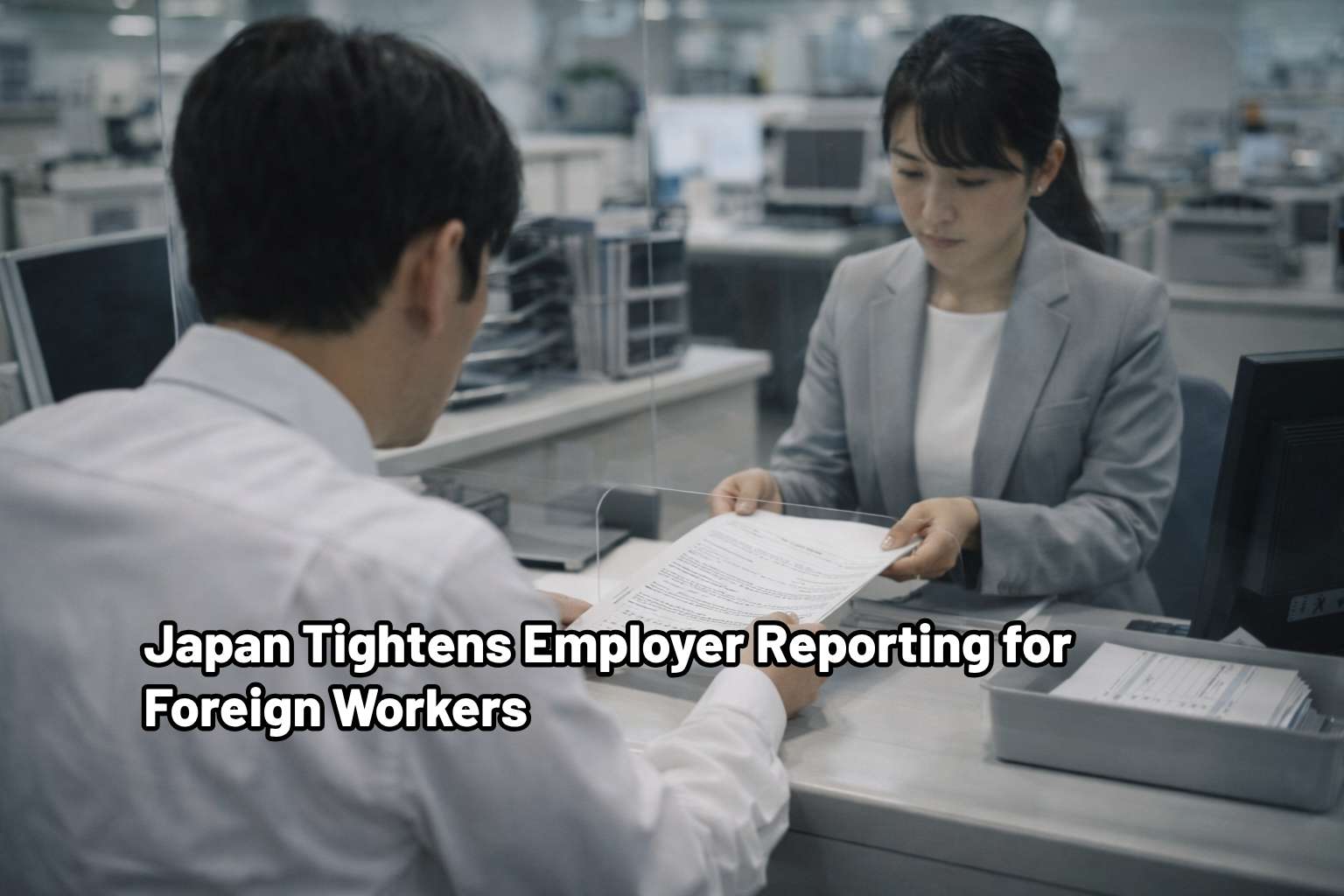
Employers are under fresh pressure to report foreign worker hires and resignations correctly.
Failure to comply could reportedly bring fines of up to ¥300,000.
Japan’s foreign worker reporting rules are under tighter official scrutiny, with employers required to report both the hiring and resignation of foreign workers. That affects businesses across sectors that employ foreign staff, while workers may also face closer document checks as companies review compliance more carefully. It matters now because authorities are publicly stressing the rules again as part of a broader push against illegal employment and improper status use.
This is not a brand-new reporting law. According to the Ministry of Health, Labour and Welfare, all employers must submit a Notification of the Status of Foreign Workers when covered employees are hired or leave, and failing to file or filing false information can bring a fine of up to ¥300,000.
Foreign Worker Reporting Rules: What Changed
What appears to be changing is the enforcement climate, not the basic existence of the obligation itself. Official guidance continues to highlight that employers must notify Hello Work when a foreign worker is hired or resigns, and that the report covers key details such as the worker’s name, status of residence, and period of stay.
Recent official materials have also encouraged employers to use the residence card reading application when checking foreign workers’ documents. That adds another layer of practical verification at the hiring stage and signals that authorities want more accurate reporting and fewer document-related gaps.
The broader policy direction is clear. The government has separately publicized a “Zero Illegal Foreign Residents Plan,” and the reporting push fits into that wider enforcement posture even if the day-to-day burden falls most directly on employers and HR teams.
Who Is Affected
The immediate responsibility sits with employers, not workers. Any company, shop, school, contractor, or service business employing foreign staff needs to treat the reporting step as a compliance task rather than a routine formality.
In practical terms, the stricter focus matters most for:
- Employers hiring foreign workers for the first time
- Companies with frequent staff turnover
- Businesses relying on part-time or non-regular foreign staff
- Smaller firms without dedicated HR or legal support
- Managers handling onboarding and resignations directly
For foreign workers, the rule does not create a separate filing duty in the same way. But it does mean employers are being pushed to confirm residence status details more carefully, especially when they are preparing notices tied to hiring, resignation, and work eligibility checks.
Old Rule vs New Rule
Old rule:
- Employers were already required to notify Hello Work when foreign workers were hired or left
- Non-compliance or false reporting was already punishable by a fine of up to ¥300,000
New reality:
- Authorities are stressing the rule more forcefully
- Employers are being encouraged to verify residence cards more carefully
- The reporting obligation is being discussed in a broader anti-illegal-employment enforcement context
That distinction matters. Businesses should be careful not to describe this as an entirely new employer obligation, but they also should not assume the rule is being treated casually anymore.
What Applicants Should Know Now
For employers, the safest approach is to review the reporting workflow before the next hire or resignation happens. According to the MHLW, deadlines depend on whether the worker is covered by employment insurance.
- If the worker is an employment insurance insured person, hiring must generally be reported by the 10th of the following month
- If that worker leaves, the report is generally due within 10 days from the day after separation
- If the worker is not an employment insurance insured person, both hiring and resignation reports are generally due by the end of the following month
It is also important to gather the necessary identity and status details before filing. Official guidance says employers are expected to confirm items such as the worker’s name, status of residence, and period of stay, and official materials note that internet-based filing is also available through the reporting system.
For businesses already feeling stretched by labor shortages, that may sound like one more administrative layer. But in compliance terms, the message from authorities is simple: report on time, confirm the details carefully, and do not treat foreign worker onboarding or resignations as informal paperwork.
Official Note
According to official MHLW guidance, the Notification of the Status of Foreign Workers is mandatory for employers when foreign workers are hired or leave, and non-filing or false filing can lead to a fine of up to ¥300,000. Official materials also show the government encouraging use of the residence card reading app, while immigration authorities have separately highlighted a broader enforcement drive through the “Zero Illegal Foreign Residents Plan.”
That does not automatically mean hiring foreign staff will become impossible or unworkable. But it does mean employers who ignore compliance basics may face more risk than before, and that could shape how some businesses think about foreign hiring going forward.
Information in this article is based on reports and official guidelines available at the time of publication and is for general informational purposes only. Japanese policies, prices, and event details change frequently. Always verify directly with official sources or licensed professionals before making travel, financial, or legal decisions.
Question for readers: Do you think stricter enforcement of employer reporting will protect foreign workers—or make companies more hesitant to hire them in Japan?