
Japan naturalization is still legally built on the five-year rule, but 2026 screening has become much stricter in practice.
That affects long-term foreign residents who want citizenship, especially people who once assumed naturalization was clearly easier than permanent residency.
It matters now because Tokyo Legal Affairs Bureau’s updated 2026 guidance says applicants must not only meet the Nationality Act’s legal conditions but also show integration factors such as daily-life Japanese ability and, in many ordinary cases, 10 or more years of residence in Japan.
This Japan naturalization guide starts with the most important point: the law and the practical screening standard are no longer the same thing. The Ministry of Justice’s English Nationality Q&A still says general naturalization requires five consecutive years of domicile in Japan with valid status of residence, but Tokyo Legal Affairs Bureau’s April 2026 guidance adds that applicants also need to be integrated into Japanese society, including everyday Japanese ability and, notably, “10 years or more” of residence as part of that integration picture.
That gap changes how people should prepare. In earlier years, many applicants focused mainly on the legal five-year threshold, basic tax compliance, and document collection. In 2026, the official Tokyo materials show a wider review: five years of tax records, two years of pension proof, a reservation-only consultation process, and much heavier attention to whether the applicant’s life in Japan looks stable, documented, and continuous.
For many foreign residents, this means naturalization is no longer something to think about only when the filing window opens. It is something you build toward over years through residence continuity, tax payments, pension compliance, record keeping, and Japanese ability. The people who succeed are increasingly the people whose paperwork tells one clean, consistent story long before they walk into the Legal Affairs Bureau.
What Changed
The biggest change is the difference between the legal minimum and the practical screening reality. Official Ministry of Justice guidance still states the basic legal domicile condition as five consecutive years in Japan, but Tokyo Legal Affairs Bureau now says integration into Japanese society includes daily-life Japanese and, in practice, 10 or more years of residence. That does not erase the law, but it does change how many standard applicants are being judged in 2026.
The second major change is the depth of financial and social compliance checks. Tokyo’s 2026 attachment list for naturalization applicants points to resident-tax documentation covering fiscal years 2020 through 2024, and it separately calls for public pension payment proof covering the most recent two years. That is far broader than the older image many applicants had of naturalization as mainly a one-year tax check plus a pile of identity papers.
The third change is procedural. Naturalization is not a mail-in process, not an online form, and not something you can casually drop off. The Ministry of Justice says the applicant must appear in person at the Legal Affairs Bureau or Regional Bureau of Legal Affairs with jurisdiction over their address, and Tokyo’s 2026 guidance makes clear that the initial consultation is reservation-only.
Another major shift is in documentation discipline. Tokyo’s 2026 guidance and handbook show that foreign-language documents must be submitted with Japanese translations, and the translation must identify the translator. The same handbook also says the statement of reasons for naturalization must be handwritten by the applicant, not typed, and not delegated to someone else.
This matters because naturalization is not judged only on your wish to become Japanese. It is judged on whether your records, your conduct, your household situation, and your language ability fit the profile of someone the government believes is fully ready to join Japanese society as a citizen. That is a much tougher standard than many people still expect from older blog posts or pre-2026 summaries.
Who Is Affected
This guide matters most for ordinary long-term foreign residents planning to naturalize through the general route. That includes workers, permanent residents, spouses, business owners, and other residents who want full Japanese citizenship rather than another cycle of residence-status renewals. The change is especially important for applicants who assumed the five-year legal rule alone would carry the case.
It also matters for people with special ties to Japan. The Ministry of Justice says some naturalization conditions are relaxed for foreign nationals with a special relationship to Japan, including those with a Japanese spouse, Japanese child, or previous Japanese nationality, under Articles 6 through 8 of the Nationality Act. That means exceptions still exist, but they are part of a legal relaxation framework, not a shortcut that removes the need for strong records and consultation.
The applicants most affected right now include:
- long-term residents who planned around the old five-year understanding
- workers with incomplete tax or pension records
- people with weak or inconsistent Japanese reading and writing ability
- applicants who have spent long periods outside Japan
- foreign spouses who believe marriage alone automatically makes naturalization simple
- residents who have not started collecting home-country records and translations yet
This is also a major decision point for people choosing between naturalization and permanent residency. Under the 2026 operational picture described by Tokyo Legal Affairs Bureau, naturalization is no longer obviously the “faster” citizenship-style route for a standard applicant. At the same time, naturalization still means becoming a Japanese national, while permanent residency remains a residence status. The legal and personal consequences are different, especially because naturalization requires, in principle, loss of prior nationality.
Old Rule vs New Rule
Old expectation:
- five years of lawful residence looked like the main threshold
- tax review was widely understood as narrower
- many applicants treated naturalization as a long document task, but not a full lifestyle audit
- the process felt distinct from PR because citizenship looked like a separate path with its own logic
New 2026 reality:
- the law still says five years, but Tokyo guidance adds integration factors including 10+ years of residence in many ordinary cases
- the document list now shows five years of tax records and two years of pension proof
- Japanese ability is treated as a practical screening issue, not a side detail
- reservation-only consultation at the Legal Affairs Bureau becomes the real gate before the filing stage
That difference is why so many residents now describe naturalization as feeling tougher than the legal text alone suggests. The written law has not simply been rewritten from five years to ten years. Instead, the practical screening framework has expanded, and applicants now need to understand both levels at once. If you only know the law, you may underestimate the bureau’s expectations. If you only know rumors, you may misunderstand what is still formally required.
[The Missing Paperwork That Can Derail Your Japan Spouse Visa Renewal]
What Applicants Should Know Now
Step 1: Check your core eligibility first
Before you do anything else, line up your case against the basic legal conditions and the newer practical screening expectations. The Ministry of Justice’s Nationality Q&A lists the general requirements as domicile, capacity, conduct, livelihood, prevention of multiple nationality in principle, and constitutional compliance. Tokyo Legal Affairs Bureau adds that daily-life Japanese ability and social integration are also expected in practice.
That means your first self-check should cover:
- lawful residence history in Japan
- age and legal capacity
- criminal and traffic record
- tax payment record
- pension and insurance compliance
- household financial stability
- whether you are prepared, in principle, to lose your current nationality
- whether your Japanese is strong enough for ordinary daily life and official procedures
Do not reduce this to one number. The 2026 naturalization picture is not only about “years in Japan.” It is about whether your records, conduct, and language ability all support the case at the same time.
Step 2: Book the preliminary consultation
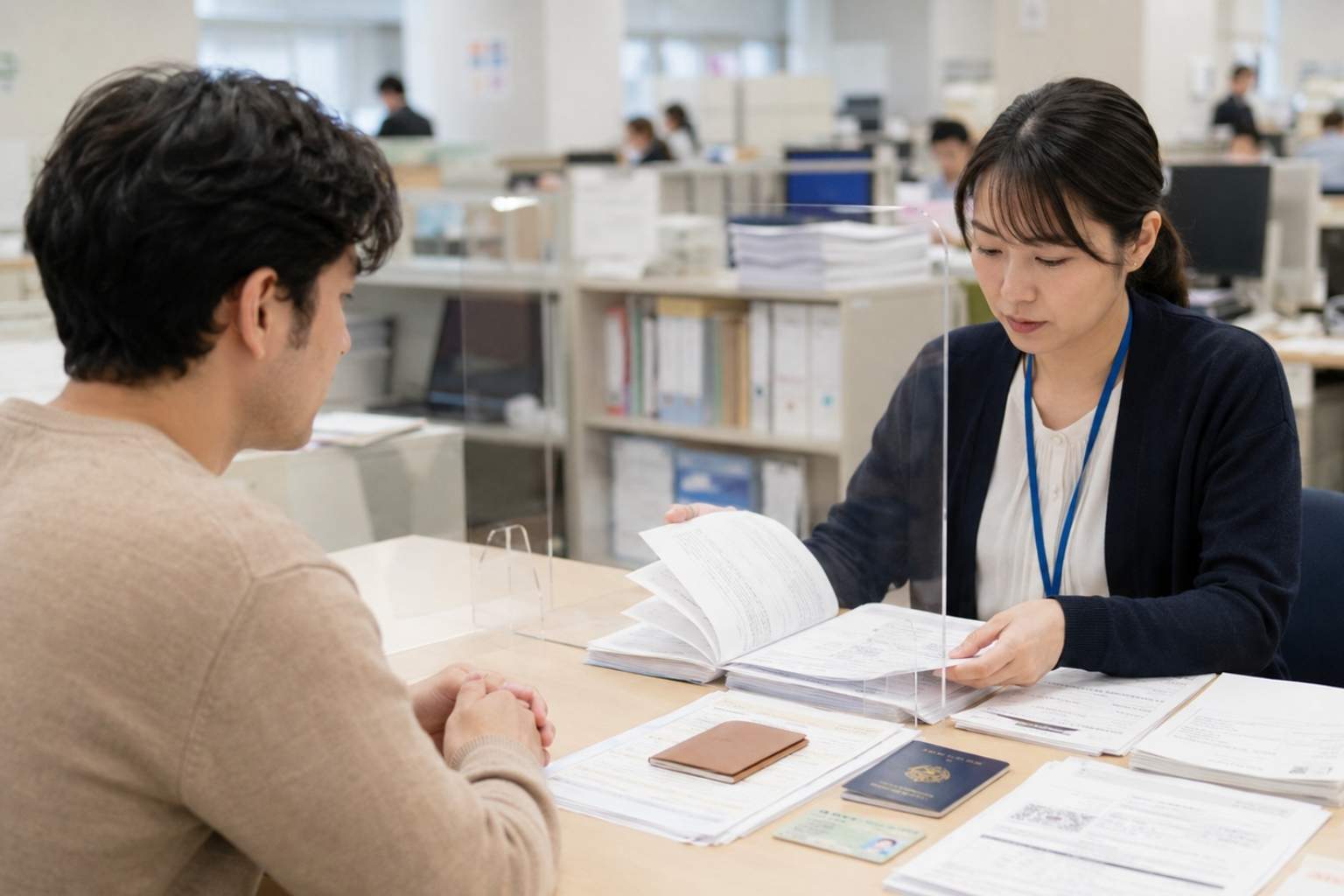
Naturalization starts with consultation, not submission. Tokyo Legal Affairs Bureau says naturalization consultation is reservation-only, and the official Ministry of Justice application page says applicants must appear in person at the office with jurisdiction over their address. In practice, this consultation is where many cases are either encouraged forward or effectively slowed down before the formal filing stage.
The consultation matters because the office will tell you which document set applies to your nationality, family structure, job history, and household situation. The Ministry of Justice also says the application forms themselves are kept at the submission office, and the required attachments differ by individual case. So there is no smart version of this process that skips the bureau and guesses the file alone.
Step 3: Gather and translate the documents
This is the longest part for most applicants. Tokyo’s 2026 checklist and handbook show that applicants may need the application forms, family-summary documents, a résumé, a handwritten statement of reasons, proof of residence history, tax records, pension records, income and asset documents, and home-country civil records such as birth and marriage certificates. Foreign-language documents must be accompanied by Japanese translations that identify the translator.
Important documents commonly highlighted in official 2026 materials include:
- official naturalization application papers
- family-summary documents
- résumé covering residence and job history
- handwritten reason statement in Japanese
- residence certificate and residence-history proof
- tax certificates and tax payment records
- public pension payment records
- employment or salary proof where relevant
- home-country birth, marriage, and family-status documents
- Japanese translations for all foreign-language materials
The reason statement is a detail many applicants underestimate. Tokyo and other Legal Affairs Bureau guidance say it must be handwritten by the applicant and not typed. That makes it part language test, part personal statement, and part proof that the applicant actually understands what they are asking for.
Step 4: Submit in person
Once the office confirms that your file is ready, you return in person to submit it. The Ministry of Justice’s application page says naturalization permission applications must be made in writing and in person by the applicant if they are 15 or older. The same page also says there is no application fee.
That no-fee point surprises a lot of people because the document burden is so large. But the real cost is time, translation, document collection, and the possibility of being asked to correct or supplement the file before it is fully accepted.
Step 5: Prepare for deeper review after filing
The Ministry of Justice application page does not publish a standard processing period, which means applicants should not expect a fast or fixed timeline. What matters more than speed is consistency. Once filed, your paperwork, tax history, pension record, household situation, and language ability may all matter more than ever because the office is now assessing a complete citizenship case, not a simple extension of stay.
This is where weak files start to show cracks. Small inconsistencies that might have felt manageable before submission become much more serious once the application is under review. That is why the strongest cases are the ones prepared early, not the ones rushed together after the consultation.
Step 6: Understand what approval really means
If naturalization is approved, the Ministry of Justice says it is announced in the Official Gazette, and naturalization takes effect on the date of that announcement. The application procedure page also explains why family-relationship documents are required: if naturalization is granted, a family register will be created for the applicant.
That is the legal finish line. But the practical finish line is bigger. Naturalization means moving from residence status to nationality. It is not just another visa success. It is the point where Japan stops treating you as a foreign resident and starts treating you as a Japanese national under a completely different legal framework.
[Japan’s Visa Fee Shock Could Hit Long-Term Residents Hard]
Official Note
According to the Ministry of Justice and Tokyo Legal Affairs Bureau, Japan’s naturalization law still states five consecutive years of domicile as the general rule, but Tokyo’s 2026 guidance also says ordinary applicants must show social integration factors such as daily-life Japanese ability and, in many cases, 10 or more years of residence. Tokyo’s 2026 checklists also point to five years of tax records and two years of pension proof, while the Ministry confirms that naturalization applications must be made in person and carry no government application fee.
For foreign residents, that creates a new kind of decision. Naturalization is still possible, still powerful, and still life-changing. But in 2026, it clearly demands longer planning, cleaner compliance, and a stronger paper trail than many applicants used to expect.
Information in this article is based on reports and official guidelines available at the time of publication and is for general informational purposes only. Japanese policies, prices, and event details change frequently. Always verify directly with official sources or licensed professionals before making travel, financial, or legal decisions.
Question for readers: Are you planning to apply for naturalization under these stricter 2026 rules, or does permanent residency now feel like the safer path?