
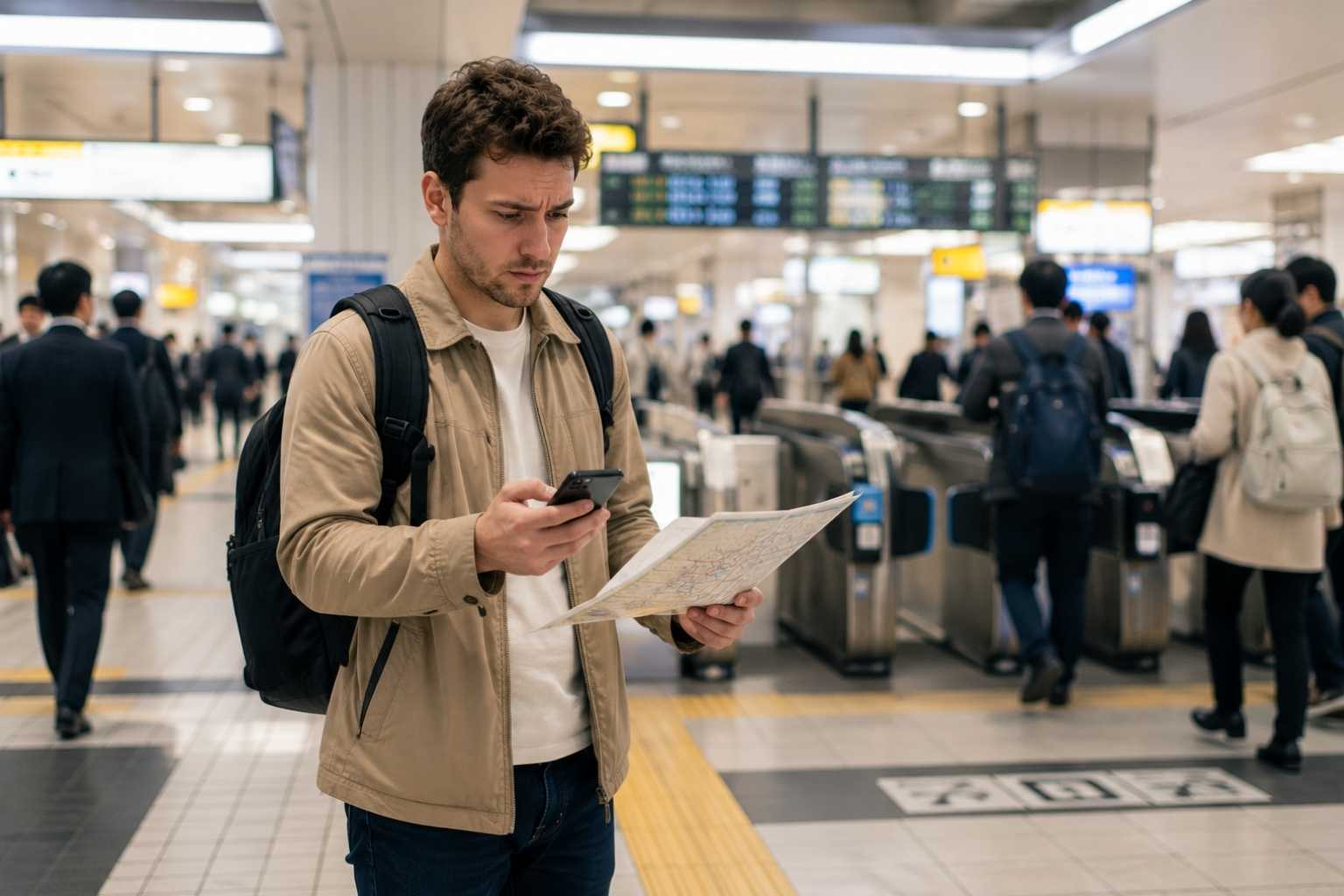
Japan’s train system looks intimidating on day one.
Once you understand the payment tools, train types, and platform manners, it becomes much easier to use.
This Japan train guide is built for first-time visitors facing a rail network that can feel overwhelming the moment they reach the ticket gates. It affects tourists, students, and new residents who need to buy tickets, choose an IC card, find the right platform, and avoid social mistakes on busy trains. It matters now because official guidance in 2026 gives clearer options for tourist IC cards, multilingual ticketing support, and rail manners that can save time and prevent avoidable problems.
The system is large, but the logic is consistent. Japan’s official travel guidance says trains are often the fastest way around major cities, while Tokyo Metro’s maps and station-numbering system help first-time riders follow line colors and station codes instead of relying only on kanji station names.
Japan Train Guide: What Happened
The first thing to understand is that “train” in Japan does not mean one single system. In big cities, you may switch between JR lines, subways, and private railways on the same day, and the trains themselves also vary: local trains stop at all stations, rapid trains skip minor stops, express trains stop even less often and may require a surcharge, while shinkansen and some limited express trains usually require or recommend reservations.
You also have two main ways to pay. You can buy individual paper tickets from ticket machines, or you can use a rechargeable IC card for faster entry through the gates. JNTO says most IC cards require a ¥500 deposit, while Welcome Suica is a deposit-free tourist card valid for 28 days; JR East says Welcome Suica remains on sale at selected airports and major stations, and PASMO’s official 2026 notice says the new TOURIST PASMO began rolling out near international-airport stations from May 2026.
If you prefer using your phone, the official JNTO train guide says mobile IC cards are also an option on supported smartphones, and JR East says the Welcome Suica Mobile app for iOS lets overseas visitors issue and top up a tourist Suica without standing in line at a station counter. That can make arrival much smoother if you already know your phone supports the service.
Once you have your ticket or card, the gate process is straightforward. JNTO says IC cards are tapped once to enter and again when you leave, while paper tickets are inserted into the gate and must be collected again on entry so you can use them when exiting. If the gate does not open, the most common reasons are a missed scan or insufficient balance, and if your fare is short, fare-adjustment machines are located near the gates.
Support for non-Japanese speakers is stronger than many first-time travelers expect. JR East says its reserved-seat vending machines support English, Chinese, and Korean, Tokyo Metro says its automatic ticket and fare-adjustment machines support multiple languages, and Tokyo Metro’s official subway map is downloadable in several languages with line colors and station numbers.
Who This Affects
This matters most if you are trying to move around Japan independently instead of relying on taxis or guided transport. It is especially useful for travelers landing in Tokyo, changing between airport trains and city lines, planning day trips, or riding the shinkansen for the first time.
You should pay the closest attention if you are:
- buying your first ticket from a machine instead of using an app or pass
- deciding whether to use a paper ticket or a rechargeable IC card
- switching between local, rapid, express, and shinkansen services on the same trip
- carrying a large backpack or suitcase during busy city travel
- unsure what to do when the gate closes or beeps at you
- trying to follow local manners without drawing attention to yourself
It also matters if you are the kind of traveler who assumes “quiet” is optional. Official etiquette guidance says phone calls on trains and buses are generally frowned upon, luggage should be kept out of the way, and people are expected to let passengers get off before boarding. That sounds minor, but these are exactly the social signals that shape whether your ride feels smooth or awkward.
Why This Matters for Travelers
The biggest mistake first-time riders make is thinking they need to understand everything at once. In reality, the system gets easier once you separate three questions: how you will pay, what type of train you are boarding, and what behavior is expected once you are inside.
For payment, an IC card is usually the simplest everyday choice. JNTO says you can top up these cards at automatic ticket machines in most stations, and they can also be used for many small purchases at station shops, lockers, and vending machines. That means one card can cover much more than just your ride.
For navigation, train type matters more than platform panic. JNTO’s rail guide says local trains stop everywhere, rapid trains skip smaller stations, and express or limited express services may need extra tickets or reservations, so checking the train type before you board is often more important than simply following the crowd.
For manners, official guidance is very clear. Keep your phone on silent, avoid voice calls, speak softly, line up to the side so passengers can get off first, and do not block the doors. Tokyo Metro also tells riders to move away from the doorway once inside and to place backpacks or large luggage on the overhead rack or hold them so they do not hit other passengers.
Food is another place where first-time travelers get mixed signals. JNTO says eating and drinking are generally fine on long-distance trains such as the shinkansen and limited express services, but eating on local and subway trains is usually considered impolite. That is why a bento on a bullet train feels normal, while a snack on a crowded commuter train can feel out of place fast.
The stress factor also drops once you know how mistakes are handled. If you buy the wrong fare, use a fare-adjustment machine. If you board the wrong shinkansen, JNTO says you should move to the non-reserved area if available and tell train staff as soon as possible. If a ticket gate shuts in front of you, step aside and fix the issue instead of freezing in place.
[The Konbini Shortcut Can Backfire Fast]
What To Know Before You Go
Before your first train day in Japan, use this checklist:
- Decide whether you want paper tickets or an IC card before you reach the gate.
- If you are staying mainly in the Tokyo area, look at Welcome Suica or TOURIST PASMO first.
- If you are using a paper ticket and are unsure of the fare, buy the cheapest ticket and adjust the difference at the destination gate.
- Read the train type, not just the platform number.
- Watch the floor markings and line up where locals line up.
- Let passengers fully exit before you board.
- Keep your phone silent and avoid calls on local trains and subways.
- Move away from the doors once you board.
- Keep backpacks and large bags out of other passengers’ space.
- Save eating and drinking for long-distance trains, not packed commuter cars.
One more tool helps more than many first-time riders realize: station numbers. Tokyo Metro says each station number combines a line letter and a number, and the circle color matches the line color, which makes transfers much easier when station names feel hard to process quickly.
If you need help, do not guess past the point of confusion. JNTO says staffed gates and station employees can assist when machines or tickets do not work, and JR East also provides multilingual support through its Infoline and travel centers. Using that help early is usually faster than trying to solve everything from the platform edge.
Official Note
According to JNTO, JR East, PASMO, and Tokyo Metro, Japan’s train basics for first-time riders are consistent across the country: buy a ticket or use an IC card, tap or insert correctly at the gates, check your train type carefully, and follow quiet-space manners once onboard. Tourist IC-card options and sales points can change, so travelers should confirm the latest official purchase locations or app availability before arrival.
[Shinkansen Luggage Rules Can Catch You Off Guard Fast]
Japan’s trains stop feeling intimidating once you understand the pattern. The people who have the easiest time are usually not the people who know every line in advance, but the ones who know how to pay, how to queue, and how to correct a mistake without panicking.
Question for readers: What confused you most the first time you used a train in Japan — the tickets, the platforms, or the quiet rules?