
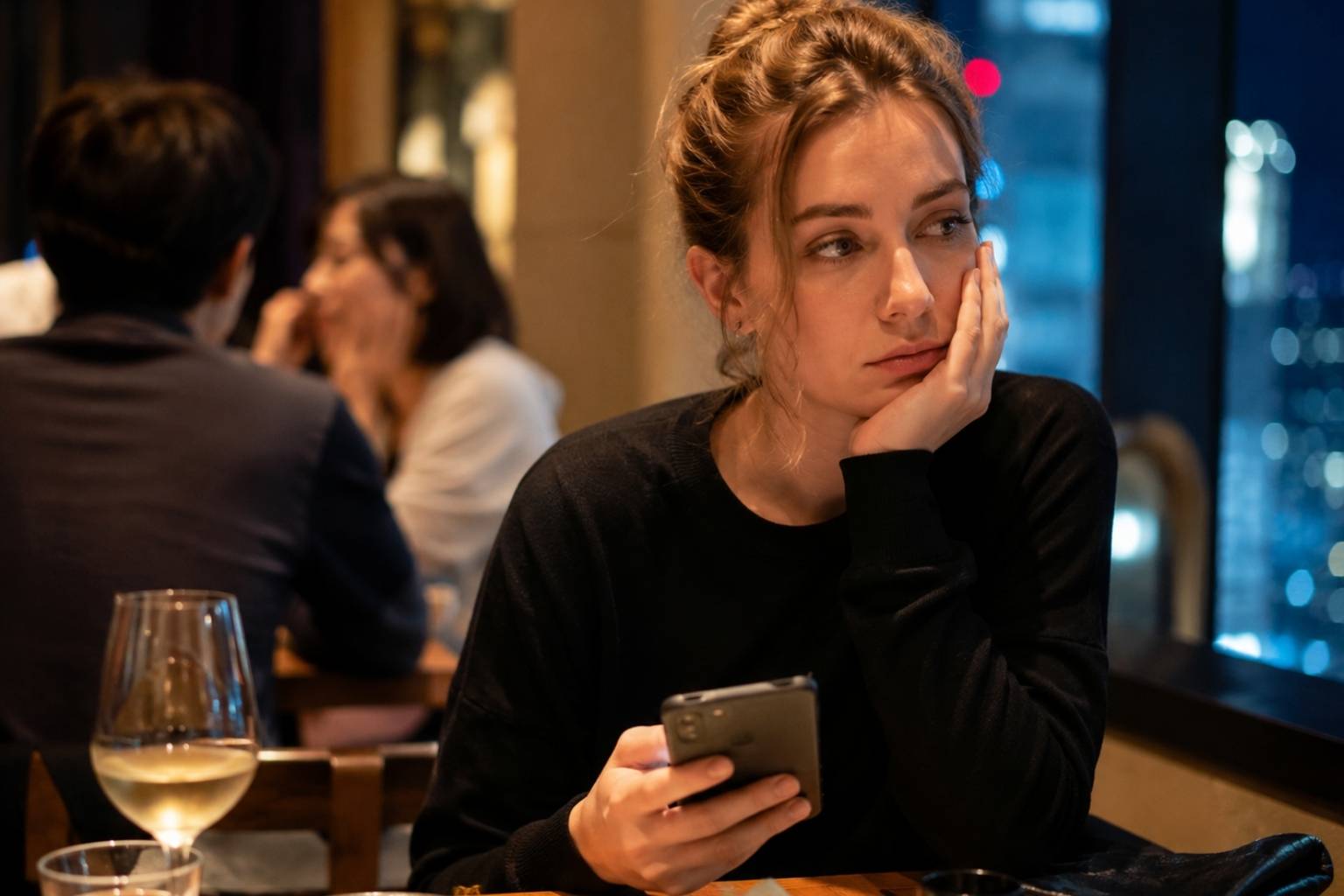
Dating in Tokyo can look exciting from the outside, but many foreign women find it emotionally draining in practice.
What begins as curiosity and hope often turns into confusion, fatigue, and distance.
Dating in Japan as a foreign woman often feels much harder than people expect. This will resonate with single female expats who arrived in Tokyo hoping for romance and instead found passive communication, culture clashes, and emotional distance. It matters because many women blame themselves for a struggle that is often rooted in deeper social and cultural disconnects, not personal failure.
At first, Tokyo can feel full of possibility.
It is huge, active, and packed with people. From the outside, that should mean choice, momentum, and new connections.
For many Western women, it does not work out that way.
Why This Story Hits Hard
The hardest part is that the dating scene often does not fail in one obvious moment.
It fails slowly.
You go out. You talk. You spend time together. But the relationship never seems to move forward with clarity. Many women describe feeling stuck in endless vague signals, half-interest, and polite but emotionally flat exchanges.
That is where the frustration starts building.
A lot of single female expats move to Tokyo expecting a modern dating culture, then run straight into deeper cultural differences around romance, gender roles, and communication. The result is not always open conflict. It is often something harder to read: confusion.
And confusion gets exhausting.
The Expectation vs Reality Shift
One of the biggest clashes comes from gender roles.
Many local dating dynamics still lean on more traditional expectations that can feel restrictive to women who are used to equality in career decisions, communication, and partnership. Western women often want partners who see them as equals in both life and work.
When those expectations collide, the disconnect shows up fast.
Another problem is how romance is pursued. In Tokyo, subtle signals are often preferred over direct communication and clear declarations. For outsiders, that can feel like passivity. Many women say they feel invisible, unpursued, or trapped in situations that never leave the platonic stage.
That is the shift that hurts most.
What initially looks polite or low-pressure can start feeling emotionally empty.
What Changed Mentally
After enough disappointing cycles, many women stop seeing the problem as a single bad date or one wrong match.
It starts to feel structural.
That is when the emotional cost becomes clearer:
- Traditional dating expectations can clash with Western ideas of equality
- Indirect communication can leave people stuck in uncertainty
- Language fluency does not solve deeper cultural gaps
- Constantly bridging lifestyle and emotional differences becomes tiring
The language barrier matters, but it is not the whole story.
For many women, it is only a small part of the problem. Humor, emotional style, pace, lifestyle priorities, and ideas of femininity can create a much deeper gap than vocabulary ever could.
[Japan’s Loneliness Industry Is Replacing Real Life]
The Hardest Lesson
The hardest lesson is that dating fatigue in Tokyo is not always about rejection.
Sometimes it is about never fully fitting the local mold.
Many foreign women find that the dating pool isolates them because they do not match expected ideas of femininity or relationship behavior. That creates a constant pressure to explain, adapt, and translate yourself in ways that go beyond language.
After a while, that pressure becomes emotional labor.
And emotional labor is exactly what many women are trying to avoid in relationships, not bring into them.
What Living in Japan Revealed
What this reveals about life in Japan is how much intimacy depends on shared assumptions.
If those assumptions are different enough, even good intentions can fail to become closeness. Two people may both be kind, interested, and trying, but still keep missing each other because the rules underneath the interaction are not the same.
That is why so many women eventually stop trying so hard.
Not because they do not want love.
Because they are tired of carrying the full weight of making every connection understandable.
What I Understand Now
The most important shift is mental, not romantic.
Women dealing with this need to understand that these difficulties are often rooted in systemic cultural differences, not personal flaws. That matters, because too many people internalize dating disappointment as proof that something is wrong with them.
It may not be.
For many, the healthier move is to stop treating romance as the only answer. Strong friendships, hobbies, and clear boundaries around equality and direct communication can matter far more than forcing a dating scene that keeps draining you.
[My Dream Job in Japan Turned Me Into a Corporate Ghost]
Final Thought
Tokyo can be exciting, but excitement does not automatically turn into intimacy.
For many Western women, dating here becomes a long lesson in how deep cultural differences can shape romance, even when both sides mean well. And once the effort starts costing more than it gives back, walking away from the dating scene can feel less like failure and more like self-protection.
Question for readers: Are you a foreign woman in Tokyo who has faced these dating struggles, or have you found a way to make cross-cultural relationships work?