
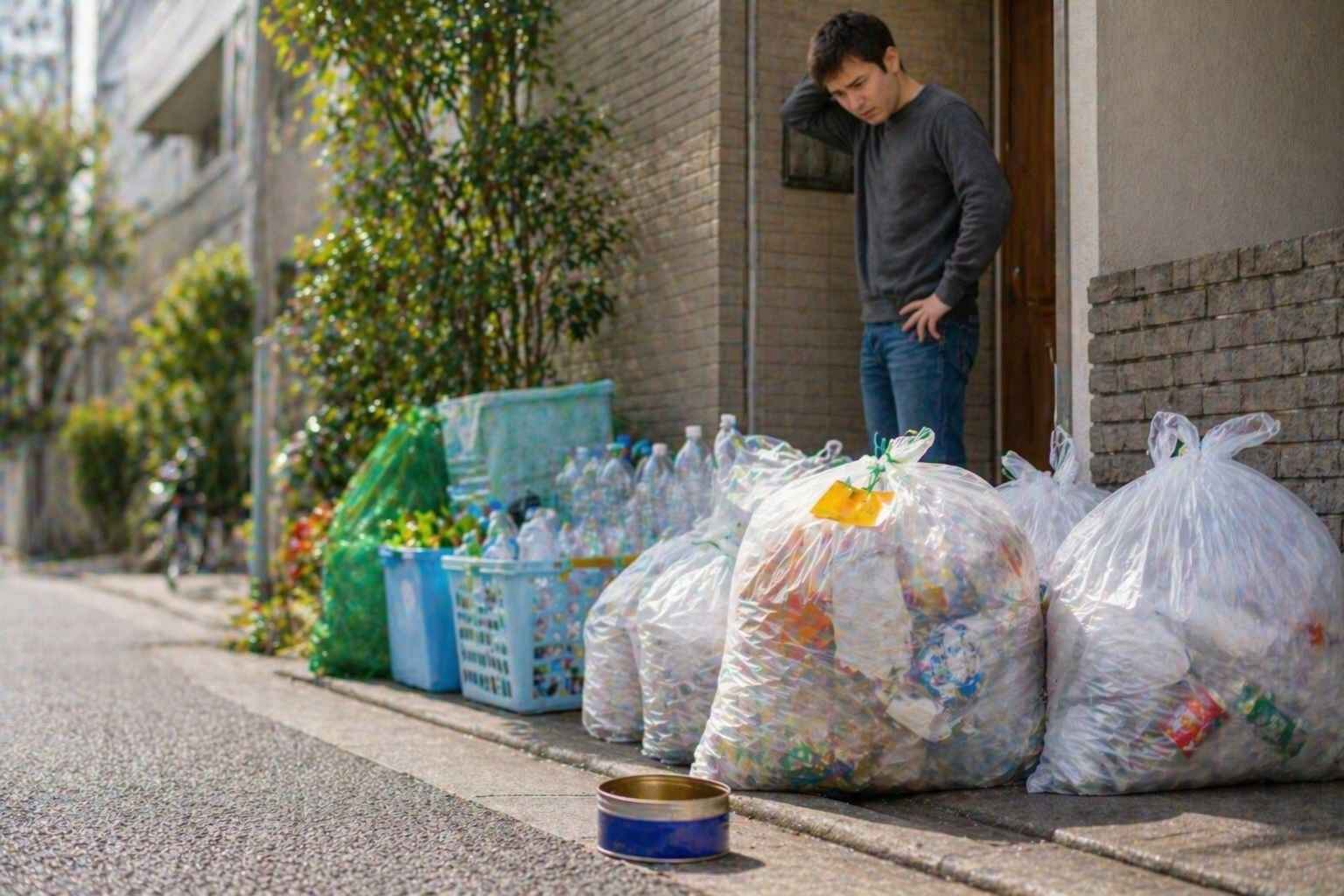
Getting your trash wrong in Japan can feel bigger than the trash itself.
This guide explains the practical stress, the social pressure, and how to handle it without spiraling.
This guide covers one of the most frustrating daily-life experiences in Japan: doing your best with trash sorting and still getting it wrong. It is for foreign residents, new arrivals, and anyone living in Japan who feels that one small mistake can suddenly become a public failure. It matters now because daily life in Japan often feels hardest not in the dramatic moments, but in quiet rule-heavy routines that keep repeating.
The emotional core of this issue is simple and brutal. You spend 30 minutes meticulously cleaning a tuna can, peel the label, soak the metal, and place it in the bin at 7:59 AM, only to find it back on your doorstep at 8:05 AM with a bright yellow violation sticker. That is not just a trash problem. It becomes a belonging problem.
For many people, that is the moment when the pressure of “fitting in” turns into something much heavier. After years of trying to read the air, change your habits, soften your voice, and avoid trouble, the thing that breaks you is not a major life event. It is one wrong piece of plastic.
Why This Guide Matters
The “Trash Police” story hits so hard because it is both funny and painful at the same time. On the surface, it is about bins, labels, and pickup timing. Underneath, it is about what happens when ordinary life starts to feel like a test you can never fully pass.
That is why this topic stays with people. The real frustration is not only the violation sticker. It is the feeling that the finish line keeps moving.
You try to be careful. You try to be respectful. You try to erase the habits that worked in your old life so you can do things “the right way” here. Then one rejected bag reminds you that trying to be perfect can become its own trap.
This guide is useful because it reframes the problem. Trash sorting matters, but your entire value as a resident does not live or die in one yellow sticker. The practical goal is to reduce mistakes. The deeper goal is to stop turning every mistake into proof that you do not belong.
In that sense, this is not just a garbage guide. It is a daily-life survival guide for anyone who has ever felt invisible, watched, corrected, or worn down by small rules that somehow never feel small.
What This Is and Who Needs It
This is a practical mindset-and-routine guide built from a familiar lived experience. It is not a legal manual, and it is not pretending that one article can erase the confusion. It is here to help you handle the pressure better, make fewer avoidable mistakes, and stop letting trash day ruin your week.
This guide is especially useful if:
- You have ever had garbage returned with a violation sticker
- You have stared at a confusing trash calendar and still felt unsure
- You clean and sort carefully but still worry you missed one detail
- You feel like a neighbor notices every mistake faster than every success
- You are exhausted from trying to be “perfect” in daily life
- You have started linking simple errors with shame or failure
It also matters if you are still new to Japan and want a healthier way to approach routines before they start affecting your confidence. Small systems are where people often feel culture shock the most, because they show up again and again. That repetition is what makes them emotionally heavy.
There is also a social angle here that many residents immediately recognize. The enemy is not always the official system itself. Sometimes it feels like the real pressure comes from the person nearby who always seems to know exactly which item you miscategorized.
That tension creates two common reactions. One group says, “Just follow the rules.” The other says, “The rules are insane.” Both reactions show up because the experience is not only practical. It is personal.
Costs, Documents, or Setup Steps
There may not be a financial cost in the story you shared, but there is clearly a time cost, an energy cost, and a mental cost. Spending 30 minutes on one tuna can is not nothing. Waking up ready to do everything right and still getting publicly corrected is not nothing either.
The practical setup begins with accepting one truth: trash sorting in Japan is not something to do casually at the last second. A rushed 7:59 AM decision is exactly where avoidable mistakes multiply.
Here is the most useful setup based on the experience described:
- Keep your local trash calendar, building notice, or sorting instructions in one visible place
- Create a simple habit of checking labels and materials before you throw anything away
- Give yourself a few minutes of buffer before pickup time instead of doing everything at the final minute
- Treat cans, labels, mixed materials, and packaging as separate decisions, not one decision
- Build a repeatable home routine so you are not re-deciding the same item every week
The strongest lesson from the tuna can story is that “careful” is not always the same as “clear.” You can be meticulous and still be unsure. That is why your system matters more than your effort in the moment.
A useful way to think about it is this: do not rely on memory, stress, or last-second judgment. Rely on a visible routine. The more your process lives outside your head, the less emotional damage one mistake can do.
If you receive a violation sticker, treat it as feedback first and humiliation second. That shift sounds small, but it matters. The sticker is telling you that your current system is not working yet. It is not telling you that you are hopeless.
[I Thought Honesty Was Respect. Japan Taught Me Otherwise.]
Common Mistakes and Practical Tips
The biggest mistake is making trash sorting part of your identity. Once that happens, every returned bag feels like a public verdict on your ability to live in Japan. That is far heavier than the actual mistake.
Another common mistake is assuming that effort alone will protect you. The tuna can story proves otherwise. You can clean, peel, soak, and still miss the exact detail that matters most in your area.
These practical tips help reduce that cycle:
- Do not wait until the last minute to sort complicated items
- Do not assume that “mostly correct” is enough for every item
- Do not let one rejected bag become a full-day emotional collapse
- Do not measure your integration by whether you never make a household mistake
- Do not ignore the visual cues around you, including stickers, notices, and calendars
There is also a deeper emotional mistake many people make without realizing it. They start erasing themselves in order to survive the routine. They change their behavior, flatten their personality, and obsess over getting everything exactly right, hoping that one day they will finally stop standing out.
But the raw truth in your story is sharper than that. You can do all of that and still end up being the person with the wrong trash.
That is why the turning point matters so much. The healthier response is not, “I will never make another mistake.” The healthier response is, “I am a human, not a machine.” That does not mean ignoring the rules. It means refusing to destroy yourself in the process of learning them.
A few practical mindset resets can help:
- Replace shame with curiosity: what exactly triggered the sticker?
- Replace panic with pattern recognition: does the same type of item keep causing problems?
- Replace perfection with consistency: can you create a better routine for next time?
- Replace self-erasure with adaptation: learn the system without making the system your whole personality
The goal is not to become untouchably flawless. The goal is to become calmer, clearer, and less emotionally fragile around an ordinary daily-life task. That is a much more sustainable form of living in Japan.
What To Do Next
If you are in the middle of your own “Trash Police” phase, start by lowering the emotional temperature. Yes, the sticker is annoying. Yes, it can feel personal. But the most useful next move is not to relive the embarrassment. It is to make the next trash day easier than the last one.
Start with one category that keeps tripping you up. Build a small repeatable rule around it in your home. Once one category feels stable, move to the next. Tiny clarity beats broad panic.
It also helps to stop telling yourself a dramatic story every time something goes wrong. A returned bag does not mean you failed at being Japanese. It means one part of your home system still needs work.
This is where many long-term residents quietly change. They stop treating correction as a crisis and start treating it as part of the adjustment process. They still care. They still want to do things properly. They just stop making daily life feel like a moral exam.
If the bigger feeling here is invisibility or self-erasure, deal with that honestly too. The trash issue might be the trigger, but the real exhaustion often comes from trying to survive every day by shrinking yourself. A healthier version of integration leaves room for effort, dignity, and mistakes at the same time.
That is the real takeaway from this guide. Learn the system. Respect the routine. Improve your process. But do not confuse adaptation with disappearing.
[Why Young Kids Travel Alone in Japan]
Official Note
This guide is based on the lived reality described above, including violation stickers, sorting confusion, pickup timing pressure, and the emotional strain of trying to fit in through daily routines. Always check the trash calendar, sticker guidance, or local instructions you were given, because the most important details are the ones attached to your own collection point and routine.
[Learning Japanese in Japan Made Me Feel Invisible]
Trash sorting in Japan can be funny in hindsight, humiliating in the moment, and strangely revealing over time. Sometimes the most ordinary routine exposes the deepest pressure you are carrying.
Question for readers: What is your most frustrating or unforgettable trash story in Japan, and did it make you more careful, more angry, or just more tired?