
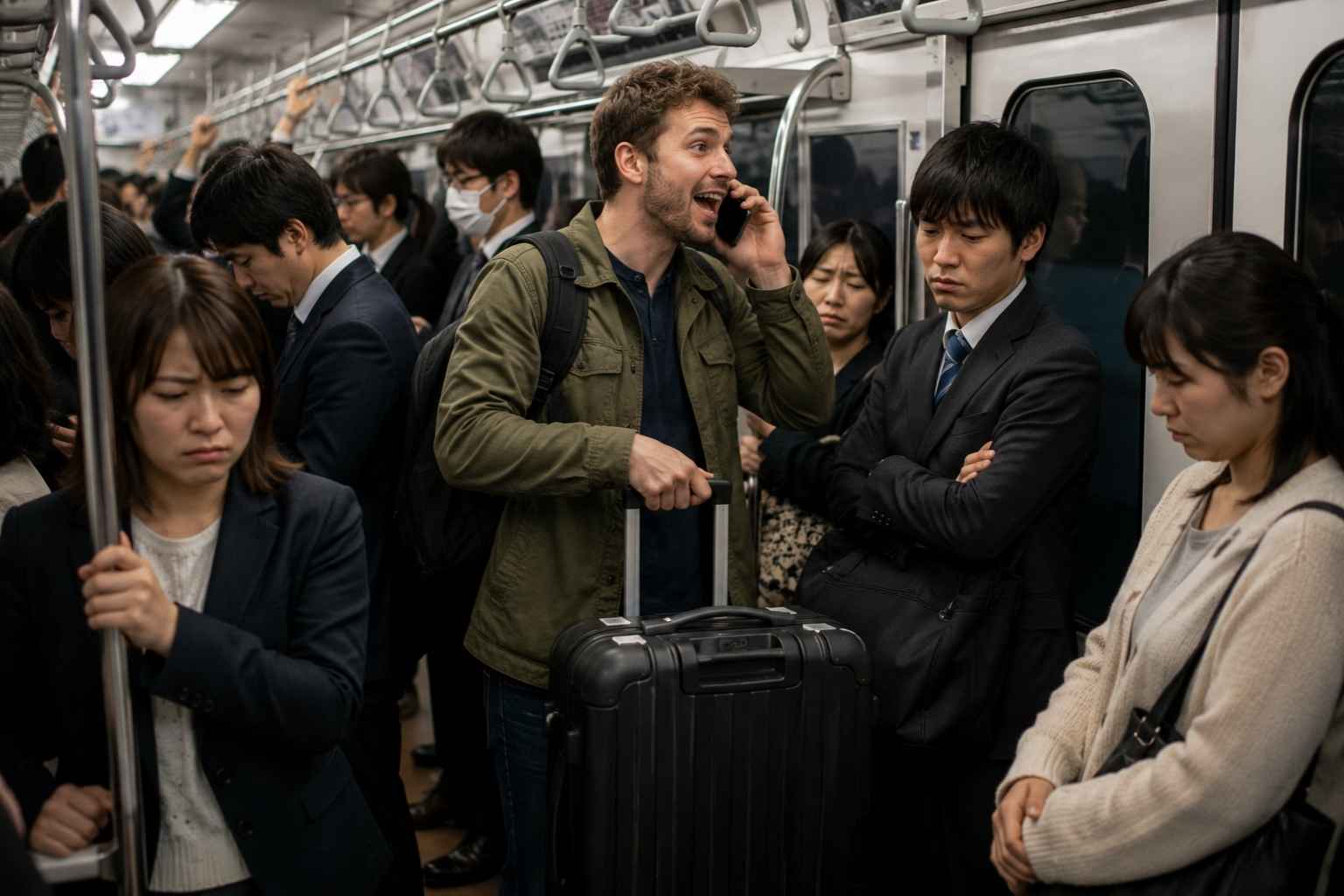
Japan rarely humiliates you out loud.
That is exactly why many tourists do not realize they crossed a line until the atmosphere already changes.
The problem with Japan tourist etiquette mistakes in 2026 is not that the rules are brand new. It is that record visitor numbers, heavier crowding, and more direct official guidance mean small habits now create friction faster than many first-time travelers expect. This mainly affects tourists moving through Tokyo trains, Kyoto streets, and other shared public spaces where locals expect quiet, flow, and awareness. It matters now because Japan hit record foreign visitor totals in 2024 and 2025, while official travel guidance has become clearer about behavior that disrupts daily life.
Japan’s own travel guidance keeps the core rule simple: do not inconvenience other people, watch what others are doing, and follow the local atmosphere when you are unsure. That sounds easy, but it also means a mistake can feel “invisible” until you notice people stepping away, going quiet, or repeating a rule more firmly.
What Happened
Official guidance from JNTO, Kyoto, JR East, and Tokyo-area transit operators now spells out more of the friction points tourists used to learn only by trial and error. The pattern is consistent: crowded trains, limited bins, noise in shared space, and behavior that blocks or disrupts sensitive neighborhoods are all getting more attention.
That makes this less about “weird Japanese rules” and more about pressure on shared space. In practical terms, these are the five Japan tourist etiquette mistakes most likely to make your trip feel awkward fast.
Who This Affects
This hits hardest if you are a first-time visitor, traveling with big luggage, moving through cities during peak hours, or copying habits that feel normal in your home country. It is especially easy to get wrong in Tokyo commuter zones and in Kyoto areas where residents live alongside major sightseeing traffic.
The five mistakes to watch are:
- bringing big suitcases onto rush-hour commuter trains
- treating any convenience store or station bin like a public dump
- using a normal conversation voice on trains and buses
- eating and drinking while walking through sensitive streets
- mistaking silence for approval instead of a sign to slow down and read the room
Japan Tourist Etiquette Mistakes That Cause Friction
1. Dragging big luggage onto peak-hour trains
JNTO says weekday commuter rush hours are roughly 7:30 to 9:00 in the morning and 5:30 to 7:00 in the evening, and during those times trains are extremely crowded, making it difficult to board with large luggage. JNTO and JR East both recommend hands-free travel or luggage forwarding, while JR East specifically says not to place bags in aisles, deck spaces, or in front of boarding doors.
2. Using private bins like they are public bins
Japan’s official etiquette guidance says public trash cans can be limited and that travelers may need to carry trash until they find one. JNTO also notes that most train stations and convenience stores do have bins, but suggests making a small purchase if you use a convenience store bin, which is a useful hint that these are not meant to be treated like unlimited public dump points.
3. Talking at your normal volume on trains
JNTO’s FAQ says people usually avoid talking loudly or making phone calls on trains and buses. For many visitors, this is one of the easiest mistakes to miss because “normal” volume elsewhere can feel too loud in Tokyo’s public transport culture.
4. Eating or drinking while walking through the wrong street
This is not a nationwide law, but it is absolutely a location issue. Kyoto’s Southern Gionmachi guidance says eating and drinking are among the prohibited acts in that area, and Kyoto’s broader sightseeing guidelines now warn against blocking roads, walking side-by-side in large groups, and ignoring designated photography rules, adding that some violations may result in fines.
5. Thinking silence means everything is fine
Japan’s official advice does not say locals will explain every rule to you. It says to observe what others are doing, ask staff when unsure, and follow the local atmosphere. The practical inference is simple: if people around you are moving differently, staff are repeating something, or the space feels quieter than you expected, take that as a real signal instead of waiting for confrontation.
Why This Matters for Travelers
The point is not to make tourists paranoid. It is to help them avoid the kind of small, preventable mistakes that make a trip feel colder than it needed to be.
Japan still works incredibly well for visitors who move with awareness. But that same system feels much less forgiving when you block the flow, break the mood, or treat every space like it exists for your convenience first.
This is also why some travelers come back saying Japan felt smooth and welcoming, while others say it felt distant. Often, the difference is not money or language. It is whether they understood that quiet public culture in Japan is not passive — it is structured, shared, and noticed.
[Eating While Walking in Japan Can Mark You Fast]
What To Know Before You Go
Before your trip, treat these as the safest habits:
- avoid commuter rush hour if you have a large suitcase
- use luggage forwarding if you are moving between cities
- keep your voice low on trains and buses
- carry your trash until you find an appropriate bin
- do not assume eating while walking is fine in every district
- if a neighborhood feels quiet or residential, act more carefully than usual
- if you are unsure, watch what locals are doing before you act
Those habits are not about perfection. They are about reducing friction before it starts.
Official Note
According to JNTO, JR East, and Kyoto’s official tourism guidance, travelers should avoid inconveniencing others, carry trash when bins are limited, keep luggage from obstructing crowded trains, avoid loud conversation on public transport, and respect stricter neighborhood rules in places like Gion and Southern Gionmachi. Travelers should treat posted rules and staff instructions as active guidance, not soft suggestions.
[Some Restaurants in Japan Do Not Want Your Phone Out]
Japan does not usually make a scene when you get something wrong. But that is exactly why the smart traveler notices the quiet rules before the room turns against them.
Question for readers: Which of these five mistakes do you think tourists underestimate the most in Japan?