
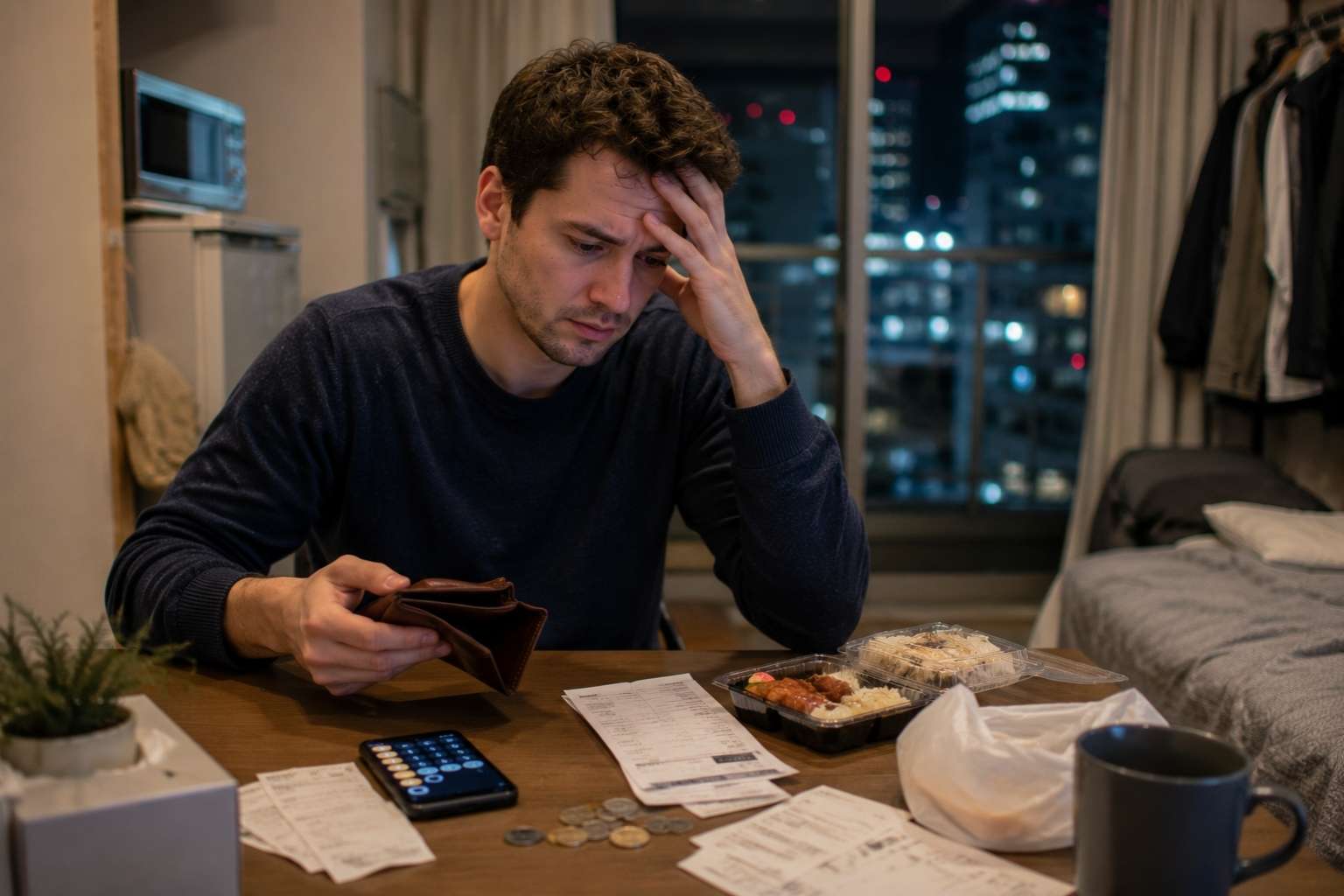
A first-person reflection on how living in Japan can look stable from the outside while quietly becoming a financial trap.
For foreigners trying to build a future here, the harder truth is that a “decent” life can still leave you with no savings and no way out.
This is about the real cost of living in Japan and how my so-called dream life slowly turned into a survival cycle. It will resonate with foreigners who work hard, pay their bills, and still feel like they are getting nowhere. It matters because the most dangerous financial trap is not obvious poverty. It is a life that looks normal while quietly draining your future.
On paper, I was doing everything right.
I was working, paying into the system, staying responsible, and trying to build something stable. From the outside, it probably looked like I was making it work.
But the reality felt very different.
The shock started with the paycheck.
Why This Story Hits Hard
Before I lived here, I thought a salary was a salary. You earn it, you budget it, and you figure life out from there.
Then I saw what actually hit my account.
The hidden deductions were brutal. Nearly 30% of my paycheck felt gone before I even saw a yen. Taxes, health insurance, pension, and all the mandatory costs that turn a “decent” salary into something much thinner the moment it becomes real.
That is where the dream started breaking.
It was not one dramatic collapse. It was the slow realization that working hard did not automatically move me forward. It only kept me in place.
And once the weak yen started squeezing everything even harder, that feeling got worse. A salary that looked manageable inside Japan started feeling weak the second I thought about anything outside it.
Trips home stopped feeling normal.
They started feeling impossible.
The Expectation vs Reality Shift
This is the gap no one really explains.
Japan can still look affordable in certain moments. You can find a cheap meal. You can keep daily life moving. You can survive.
But survival is not the same as building a future.
That is where the middle-class trap starts. You earn too much to feel like you qualify for help, but too little to create any real margin. Too little to save properly. Too little to travel freely. Too little to feel secure.
So you keep going.
You go to work, come home tired, buy the discounted convenience-store bento, and tell yourself this is temporary. Then the weeks pile up. Then the months. Then suddenly the “dream life” is just ten hours of work followed by a meal that feels more like damage control than reward.
What Changed Mentally
The hardest part was not just the numbers.
It was what the numbers did to my thinking.
When money gets tight for long enough, life gets smaller. You stop planning ahead. You stop imagining choices. You stop thinking in terms of growth and start thinking only in terms of what can be delayed, cut, or survived.
A few things became painfully clear:
- Hidden deductions can destroy your sense of financial control
- A weak yen can make a normal salary feel internationally useless
- You can work full time and still feel too poor to move forward
- Being stuck is not just financial; it becomes emotional
That is when the whole thing stopped feeling like a rough patch and started feeling like a trap.
[The 5-Year Visa Trap That Could Sink Your PR Plan]
The Hardest Lesson
The hardest lesson was realizing I could not even afford to leave easily.
That sounds extreme until you live it.
When savings are gone, even escape becomes expensive. Moving fees, deposits, travel costs, and the basic expense of changing your life start feeling completely out of reach. You are not just living paycheck to paycheck.
You are pinned in place by it.
That creates a very specific kind of despair. Not loud. Not dramatic. Just the quiet understanding that your life has become smaller than you expected, and fixing it will cost money you do not have.
What Living in Japan Revealed
Living here revealed that financial pressure does not always look chaotic.
Sometimes it looks clean.
It looks like a normal apartment, a regular job, and a person who seems functional from the outside. But underneath that surface is constant calculation. Can I afford fruit this week, or do I need to hold that money for the mandatory fees? Can I save anything at all? Can I visit home? Can I leave if I need to?
That is the real cost.
Not just the bills themselves, but the way they shrink your life.
What I Understand Now
I understand now that the problem was never just that Japan was “expensive.”
The problem was that the structure of life here made it easy to look stable while quietly becoming financially cornered. That is what broke my spirit more than anything else.
I was not chasing luxury.
I was chasing enough room to breathe.
And that is a very different thing.
[Japan’s One-Card ID Shift Has Started — But It’s Not Mandatory]
Final Thought
The real cost of living in Japan is not only what gets taken from your paycheck. It is what gets taken from your future when hard work keeps you alive but never lets you move.
That is what I wish more people understood.
A dream life is not a dream if it leaves you with zero savings, constant pressure, and no clear way out.
Question for readers: Do you think Japan is becoming too expensive for foreigners to actually build a future here?