
Japan’s falling birth rate is no longer just a money story.
For many young workers, the deeper issue is exhaustion so constant that relationships, family life, and even basic rest start slipping out of reach.
This article is about the growing sense among young workers in Japan that overwork is no longer just a career problem. It will resonate with readers trying to understand why family life, dating, and even ordinary relationships can feel impossible to sustain under long work hours and shrinking personal time. It matters because when adult life is reduced to commuting, working, and recovering just enough to repeat it, the damage reaches far beyond the office.
Japan’s record-low birth rate is often discussed through the language of economics, subsidies, and demographic anxiety. But for many workers, the reality feels more immediate and more physical.
They are tired.
Not casually tired. Not the kind of tired that disappears after a weekend. The kind of tired that changes how a person lives, what they can build, and how much of themselves is left by the end of the day.
A 26-year-old software engineer in Tokyo says he leaves home at 7:00 AM and returns close to midnight almost every day. He has not seen his father in three years, even though they live in the same city.
That detail says more than most policy speeches ever could.
Why This Story Hits Hard
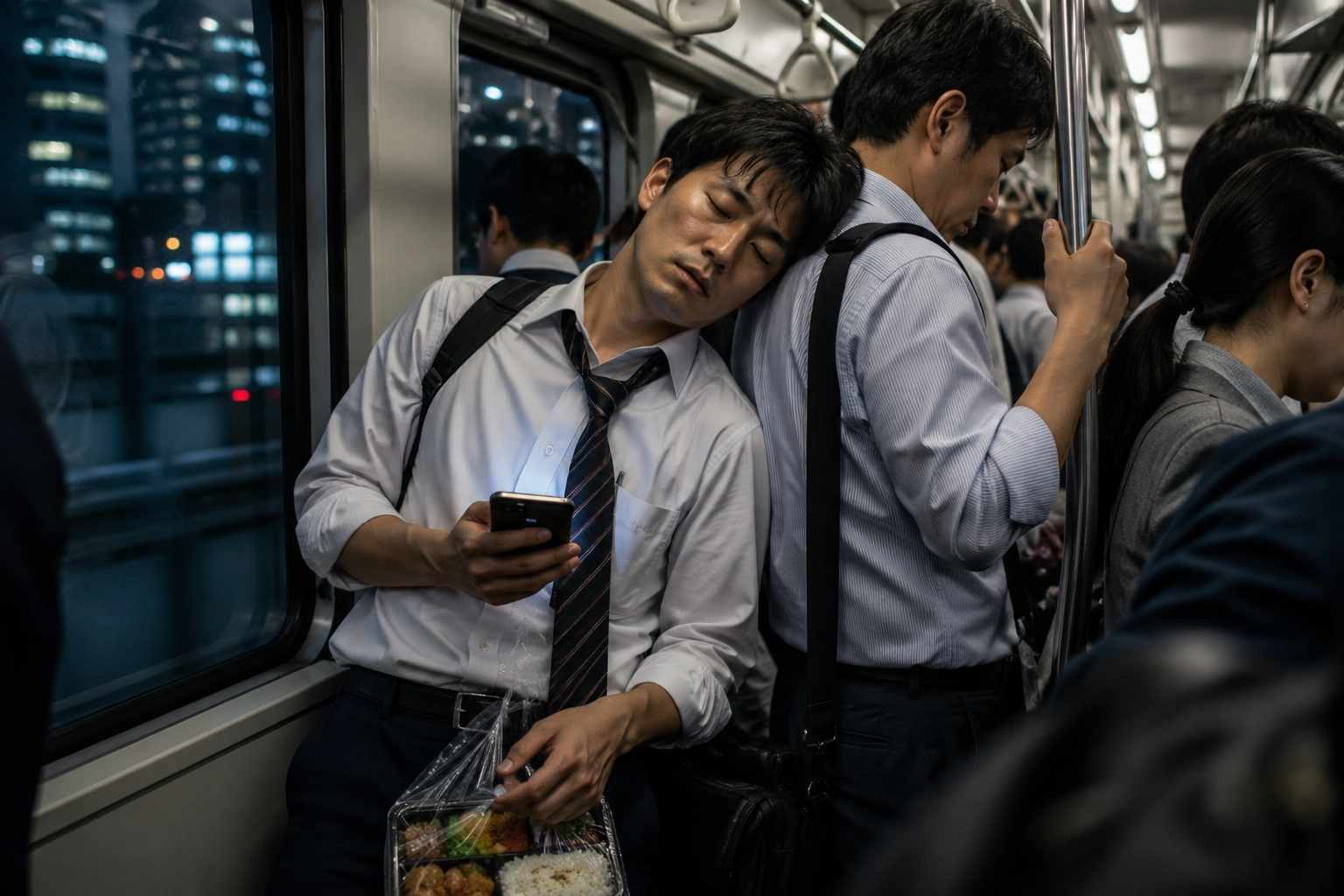
The image is not abstract. It is ordinary.
A young worker asleep standing on the Chuo Line beside another exhausted commuter doing exactly the same thing. A phone still in hand. A convenience-store meal hanging from one wrist. Another day ending inside a train instead of inside a life.
That is what makes this story hit so hard. It is not just about the birth rate. It is about the slow disappearance of time itself.
The government is offering housing support, cash incentives, and dating programs to encourage young people to start families. But many workers are saying the same thing: the problem is not only money.
The problem is that there is no time left to be a person.
No time to date properly. No time to maintain relationships. No time to recover. No time to see family, even when they live nearby. No time to imagine building a future that requires energy, attention, and emotional space.
That turns what sounds like a private life decision into something much bigger.
The Expectation vs Reality Shift
For years, the idea of success in Japan has been tied to reliability, long hours, and endurance. Keep going. Stay late. Show commitment. Be present. Do not be the one who leaves early. Do not be the one who disrupts the rhythm.
From the outside, that can still look like discipline.
From the inside, it increasingly looks like survival.
That is where the expectation-versus-reality shift becomes impossible to ignore. What was once framed as ambition now feels to many workers like a system that consumes the exact years when people are supposed to be building adult life.
Mandatory overtime and weekend “team building” still dominate office culture for many workers. Long commutes and shrinking personal time are becoming normal. Relationships begin to feel fragile before they even have a chance to become stable.
And when the government responds mainly with incentives, a harder question starts to surface: what exactly are people being encouraged to build if the structure of daily life leaves no room to live inside it?
What Changed Mentally
This is where the emotional truth of the issue becomes sharper.
When work takes nearly every waking hour, people do not just lose time. They lose the ability to imagine a different shape for life. The future starts shrinking.
Here is what that reality reveals:
- Overwork does not only hurt health; it narrows what people believe is possible
- Long commutes turn private life into leftover time
- Constant exhaustion makes intimacy feel like another task instead of a source of meaning
- A society can encourage family formation while still structuring daily life against it
That is why the issue no longer feels like a simple debate over personal priorities. Many workers are not saying they do not want relationships or family life. They are saying the current structure leaves too little of them available to build either one.
The Hardest Lesson
The hardest lesson in this story is that a functioning system can still be deeply draining.
Japan is often admired for efficiency, order, and reliability. But systems that run smoothly on the surface can still be sustained by people quietly absorbing impossible pressure underneath. That pressure does not always show itself dramatically.
Sometimes it looks like silence.
Sometimes it looks like politeness.
Sometimes it looks like a young worker too tired to sit up straight on the train home.
That is why this no longer feels like an issue of personal weakness or poor planning. If work leaves no time for family, relationships, or even sleep, then what is being protected is not really a healthy model of success.
It is endurance.
And endurance is not the same thing as a life.
What Living in Japan Revealed
What this reveals about living in Japan is not only that the work culture is demanding. It is that the demand does not end at the office door.
It follows people onto trains. Into tiny apartments. Into missed dinners. Into family ties that weaken from sheer lack of time. Into relationships that cannot get off the ground because there is nothing left to give them.
That is why the birth rate conversation feels so much bigger than numbers.
It is about energy.
It is about whether adult life in Japan still leaves room for anything beyond function.
It is about whether people are being asked to maintain the appearance of stability while quietly losing the capacity to build the very future they are being urged to create.
What I Understand Now
The deeper issue is not that young workers have stopped caring about family life.
It is that many feel modern work has pushed life itself out of reach.
A society can offer support, incentives, and programs. But if ordinary days still leave workers depleted, isolated, and unable to sustain real connection, then those measures will keep colliding with the same wall.
Time is not a side issue here.
It is the issue.
And until that changes, more young workers will keep looking at the promise of family life and seeing not hope, but another impossible demand.
Final Thought
Japan’s lowest birth rate for the tenth straight year is often treated like a national emergency on paper. But on the ground, it can look much quieter: a young worker getting home near midnight, too tired to speak, too tired to love well, too tired to imagine building anything beyond tomorrow.
That is what makes this story so difficult.
A society can stay orderly, efficient, and outwardly calm while still asking people to trade away the hours that make life feel human. And once that happens, the question is no longer why people are delaying family life.
The question is how they were ever supposed to build one in the first place.
Question for readers: If work leaves no time for rest, relationships, or family, does that still sound like success to you?