
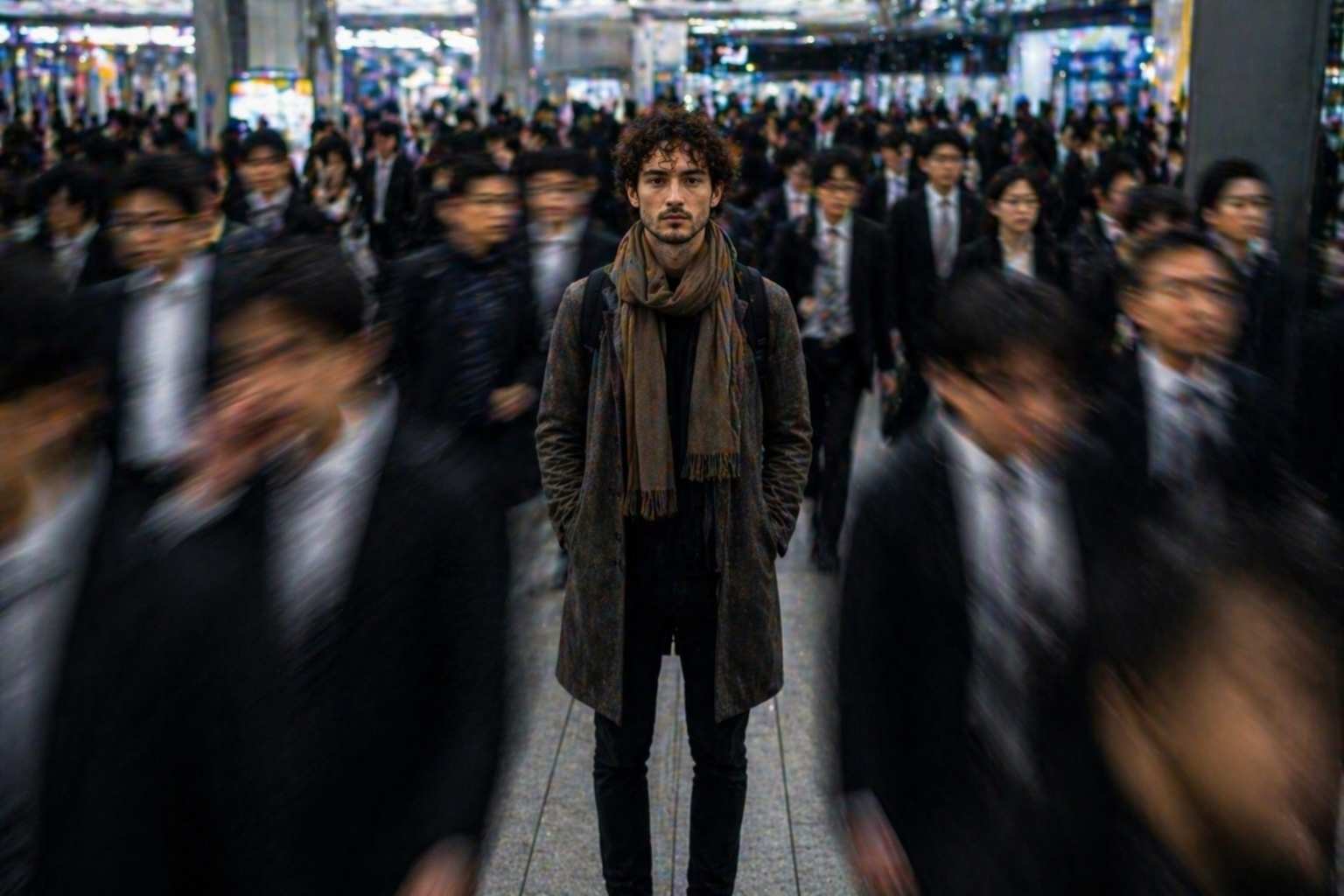
A first-person reflection on the hidden exhaustion behind Japan’s flawless daily life.
For anyone who has admired the system here, then slowly realized someone is paying for that perfection every single day.
This is about the moment I stopped seeing Japan only as a perfect system and started seeing the human exhaustion underneath it. It will resonate with anyone who has lived here long enough to notice that order, efficiency, and calm often come with invisible pressure. It matters because the most polished places can sometimes ask the most from the people holding them together.
At first, I was amazed.
Everything worked. Everything was clean. Everything was on time. No chaos. No noise. No visible problems. It felt like the world finally made sense.
That was the version of Japan I fell in love with.
Then, after a while, I started noticing the cracks.
Not in the system.
In the people.
Why This Story Hits Hard
Once I saw it, I could not stop seeing it.
The man in the suit asleep on the train at 8 PM. The cashier still smiling at 11 PM. The kind of silence that no longer felt peaceful, but tired.
That was when it hit me: things do not break here because people do.
Back home, when something goes wrong, people complain. They push back. They show frustration. Here, what I kept seeing was different. People absorbed it. They stayed longer. Worked harder. Said less.
And because they absorbed so much, the system kept looking perfect.
That is what makes this story hit hard. The success of the system can hide the cost of maintaining it. If you are only looking at outcomes, everything looks admirable. If you look at faces, timing, posture, and energy, the story starts changing.
The trains still run.
The counters still stay open.
The meetings still move forward.
But behind all that smoothness, you start sensing how much of daily life depends on people swallowing their own fatigue.
The Expectation vs Reality Shift
When I first moved here, I thought this level of order meant I had found a better way to live.
I thought efficiency would make life easier. I thought fewer problems meant less stress. I thought a society that ran this smoothly would naturally feel healthier to be part of.
But living inside it felt different from admiring it.
The longer I stayed, the more I understood that smoothness is not the same as ease. Sometimes it is the result of constant self-control. Sometimes it is the result of people carrying pressure so quietly that outsiders mistake it for peace.
That was the real expectation-versus-reality shift for me.
I had assumed perfection meant comfort.
Instead, I found that perfection often meant maintenance.
And maintenance meant somebody was always paying.
What Changed Mentally
At first, I tried to match it.
I stayed late. I never said no. I tried to be easy, reliable, and perfect. I thought that was what belonging looked like. I thought respecting the culture meant matching its rhythm as closely as possible.
But the more I adapted, the more drained I felt.
I started noticing that I was not becoming stronger. I was becoming quieter, flatter, and more mechanical. It felt like I was slowly turning into part of the machine I admired.
That realization sharpened for me one night in a late ramen shop.
I looked around and everyone seemed to carry the same expression: quiet, tired, empty. Not dramatic. Not broken in some obvious way. Just running.
That moment stayed with me because it showed me what life could become if I kept trying to mirror everything perfectly.
Here is what I finally understood:
- Efficiency can hide exhaustion
- Silence can mean people have nothing left to say
- Perfection is often maintained by people who feel they cannot fail
- If you try to match the system completely, you can lose yourself inside it
[Japan Trash Sorting Survival Guide: How to Handle the “Trash Police” Without Losing Yourself]
The Hardest Lesson
The hardest lesson was that Japan is not broken.
It works too well.
And that is exactly why it can be dangerous for people like me, especially when I started confusing admiration with surrender. I thought respect meant total adaptation. I thought if I matched the pace, the restraint, and the reliability around me, I would eventually feel stronger here.
Instead, I felt smaller.
That was the uncomfortable truth: I was not being forced in some obvious way. I was participating. I was volunteering my energy to maintain an image of life that looked flawless from the outside.
And because the rewards were subtle, it was easy to stay inside that cycle for too long.
A stable routine. A calm life. No obvious conflict.
It looked good.
It just did not feel alive.
What Living in Japan Revealed
Living in Japan revealed that a system can be admirable and still ask too much from people.
I still respect the discipline here. I still understand why so many people admire the order, the cleanliness, and the precision. Those things are real. They matter.
But now I also see the human cost more clearly.
I see how easy it is to confuse restraint with wellness. I see how easy it is to mistake silence for peace. And I see how quickly a person can start trading their energy for a life that looks beautiful from the outside.
That is what changed for me.
Not the system.
Me.
What I Understand Now
I stopped trying to be perfect.
I left on time more often. I spoke more. I allowed myself to be a little wrong. I stopped treating every small act of self-protection like some kind of failure to adapt.
That shift did not make Japan less efficient.
It made me more human inside it.
And that is what I understand now: you do not have to burn out to respect the culture. You do not have to empty yourself out just because the system around you keeps moving. You can admire how things work here without offering your whole nervous system as payment for it.
That was the real turning point.
Not escaping the system, but refusing to disappear inside it.
[Moving to Japan Meant Letting My Old Self Go]
Final Thought
Japan still amazes me.
But now when I look at the precision, the calm, and the perfect timing, I also think about the people carrying it. That changed the way I live here. It made me less impressed by appearances and more concerned with what daily life costs the people sustaining them.
A flawless system is not always a healthy one to mirror completely.
Sometimes the bravest thing you can do in a place like this is stay human.
Question for readers: Have you ever lived in a place that looked perfect from the outside but felt exhausting to be part of?