
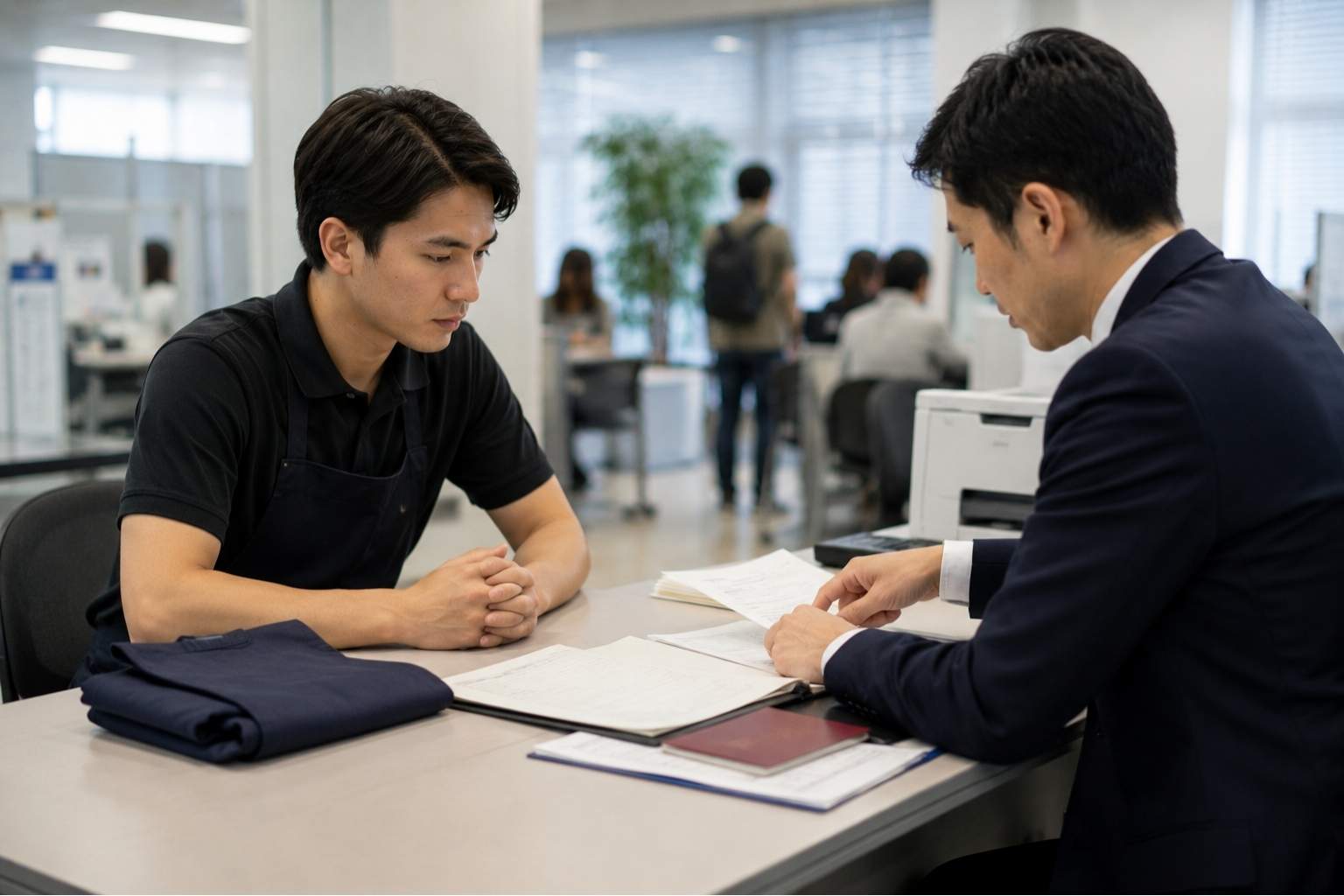
The easiest SSW route for many restaurant workers is no longer open in the same way.
New food service applications are now hitting a hard wall, and many people who thought they could switch later may already be too late.
The Japan SSW food service suspension now blocks most new food service COE applications and most new change-of-status applications accepted from April 13, 2026. That directly affects overseas applicants, students in Japan hoping to switch into restaurant work, and employers planning to hire through the food service SSW route. It matters now because the Immigration Services Agency says the sector was already at about 46,000 workers at the end of February and was expected to exceed its 50,000 intake ceiling around May.
According to official ISA guidance, this is not a rumor or a soft slowdown. It is a formal cap-control measure tied to the food service sector’s five-year intake ceiling, and the agency posted the suspension and the new handling rules on its SSW updates page in April 2026.
Japan SSW Food Service Suspension: What Changed
The key shift is procedural but brutal in practice. The ISA said on March 27 that the food service sector was on track to pass its upper limit, and from April 13 it moved to stop issuing new Certificates of Eligibility for this category when those applications were accepted on or after that date.
The same notice also changed the rule for people already in Japan who wanted to switch into SSW food service. Applications for a change to Specified Skilled Worker No. 1 in food service that were accepted on or after April 13 are, in principle, denied, with only narrow exceptions.
Those exceptions are limited. Officially, continued normal review remains available mainly for:
- people already in SSW food service who are changing jobs inside the same sector
- people finishing the specific technical intern track for medical and welfare facility meal preparation and moving into SSW food service
- people already holding the special preparatory status for transition into SSW food service
That means this is not just a slower queue. For many applicants, it is a closed gate.
Who Is Affected
The biggest shock falls on people who were treating food service as the most realistic bridge from study or part-time work into full-time status. If they had not already filed before the cutoff, the official rules now make that path much harder.
The groups most exposed are:
- overseas applicants needing a new food service COE
- students in Japan hoping to change status into SSW food service
- employers waiting to sponsor restaurant or hospitality workers through this route
- workers in Japan who assumed there would be a normal waitlist after the cap tightened
The waitlist issue matters because the official notice does not describe a general queue for post-cutoff filings. It says COE applications accepted on or after April 13 are not issued, and change-of-status applications accepted on or after that date are, in principle, not permitted.
Old Rule vs New Rule
Old reality:
- food service remained one of the most accessible SSW routes
- normal COE and status-change applications could still move through review
- the five-year sector ceiling for food service was 50,000 people under the current intake plan
New reality:
- the sector was already near the cap by late February 2026
- COE applications accepted from April 13 are not issued
- most new changes into SSW food service accepted from April 13 are denied in principle
- only narrow exceptions remain, mainly for same-sector movers and a small number of transition cases already identified by the government
That is why this feels bigger than a routine quota update. A path many people thought was still open has effectively become a deadline story.
[Japan Permanent Residency Language Requirements 2026]
What Applicants Should Know Now
The first thing to check is your filing date, not your exam result. If your COE or status-change application was accepted before April 13, the official notice says it can still be reviewed within the intake range, although delays are expected because applications from people already in Japan are being prioritized.
If you missed that date, the safest assumption is that the ordinary food service route is no longer available right now. That does not mean every foreign worker is out of options, but it does mean many people will need a new strategy instead of waiting for the restaurant sector to reopen automatically.
A practical checklist now looks like this:
- confirm the exact date your application was accepted
- check whether you fall into one of the official exception categories
- do not assume a rejected food service filing will convert into a queue place later
- ask whether a same-sector transfer, preparatory status, or another visa route is realistically available
- look at other SSW fields only after checking their own exams and sector rules first
For some applicants, automobile transport may now look like an alternative because that SSW field is open and has its own intake estimate and sector test. But it is not a simple replacement for food service. Official transport guidance says the sector has its own evaluation exam structure, and the five-year intake estimate there is 24,500, not an automatic overflow lane for restaurant workers.
Official Note
According to official Immigration Services Agency notices, the food service SSW sector was projected to exceed its 50,000 intake ceiling around May 2026, leading to a formal cap-response policy. The ISA says new food service COEs accepted on or after April 13 are not issued, and most new changes into SSW food service accepted on or after that date are denied in principle, with only limited exceptions.
That leaves many applicants in a much worse position than they expected. The food service route is not just slower now. For a large share of new applicants, it is effectively shut unless they already got in before the line moved.
Information in this article is based on reports and official guidelines available at the time of publication and is for general informational purposes only. Japanese policies, prices, and event details change frequently. Always verify directly with official sources or licensed professionals before making travel, financial, or legal decisions.
Question for readers: If the food service SSW path is effectively blocked now, should Japan raise the cap fast — or should applicants be pushed into other sectors instead?