
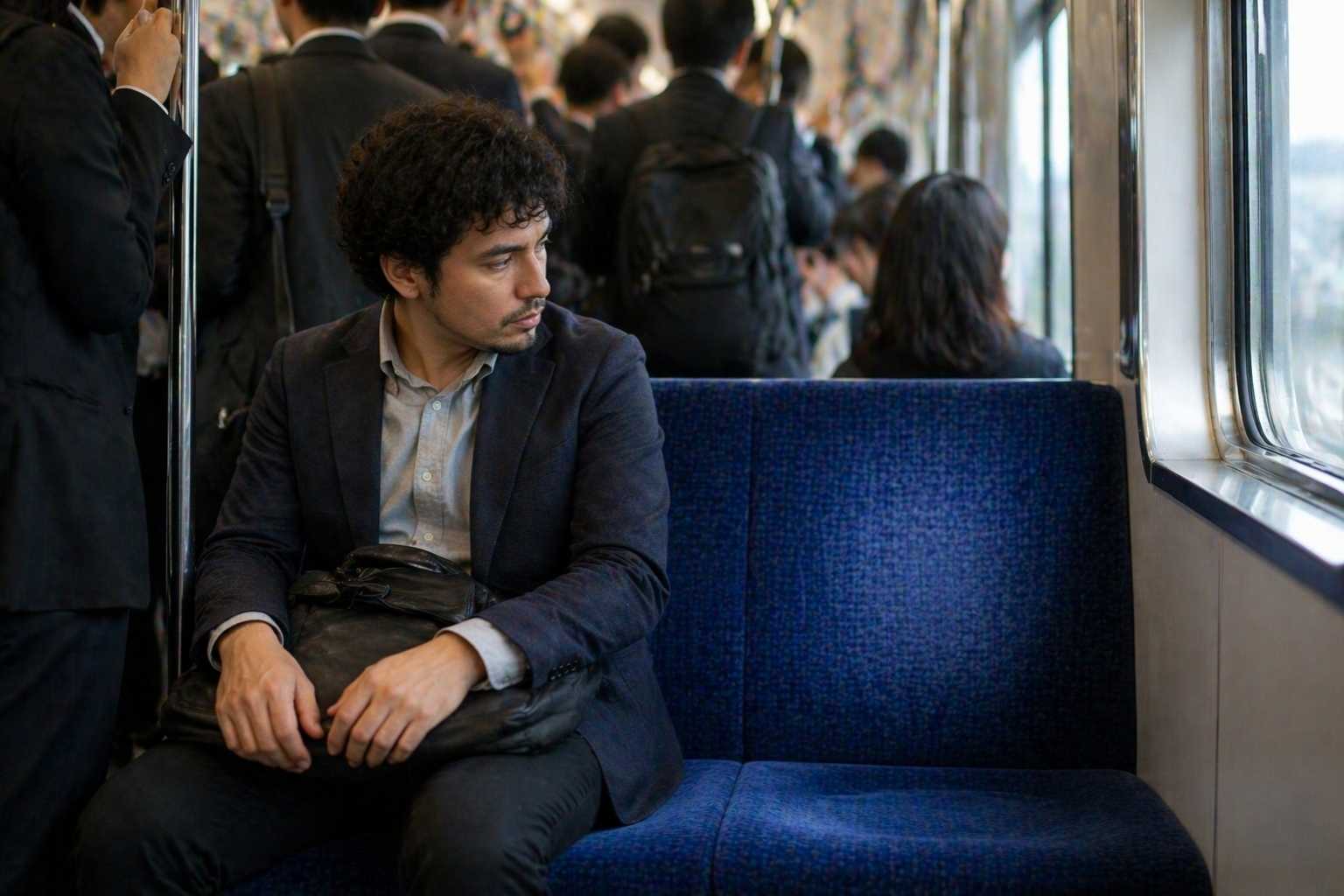
A practical guide to one of the quietest, most awkward moments in daily life in Japan.
How to handle the packed-train empty seat without turning every ride into a verdict on yourself.
This guide covers the empty seat next to you on crowded trains in Japan, what makes it feel so loud emotionally, and how to handle it in a practical way. It is for foreign residents, students, workers, and long-term visitors who have noticed the pattern and started wondering what it means. It matters now because small repeated moments like this can wear you down faster than bigger dramatic problems, especially when commuting is already part of your everyday life.
Nothing makes you feel more visible in Japan than an empty seat. The train is full, people are standing, and still the spot beside you stays untouched. At first you tell yourself it is nothing, but when it keeps happening, it stops feeling random and starts feeling personal.
That is what makes this such a difficult “Living in Japan” topic. It is not openly hostile. It is not dramatic. It is just small, quiet, and strangely exhausting.
Why This Guide Matters
The empty seat next to you matters because it sits right in the gap between what other people see and what you feel. From the outside, it can look like nothing happened. From the inside, it can feel like the whole train just said something without speaking.
That contrast is what makes it so unsettling. The moment looks polite, calm, and socially invisible. But inside your own head, it can become a rapid-fire loop of questions.
You start wondering if it is your face, your size, your bag, or just the fact that you are foreign. You tell yourself not to overthink it, and then the same thing happens again on another ride. The repetition is what makes a small moment start to feel like a message.
This is why the “empty seat” lands differently from other awkward commuter moments. It is not one loud confrontation you can point to and explain. It is a silent pattern that can slowly chip away at your sense of ease.
That is also why it belongs in an evergreen guide. This is one of those Japan moments that many people feel but do not always know how to talk about. It does not make the highlight reel, and it does not look big enough for public drama, but it can stay with you for a long time.
Some days it feels like blessed extra legroom. Other days it feels like the “gaijin seat.” Both reactions can exist at the same time because the moment itself is ambiguous, and ambiguity is what makes it mentally exhausting.
The hardest part is that the seat never explains itself. You are left to fill in the blank. Once that starts happening repeatedly, commuting becomes more than getting from one place to another. It becomes a quiet test of whether you feel normal, tolerated, or somehow marked.
There is also a deeper reason this hits so hard. Daily life in Japan often asks people to endure small discomforts without making a scene. That can work for a while. But when the same small discomfort keeps returning, it starts to feel less like patience and more like emotional fatigue.
This guide matters because the goal is not to prove one meaning behind every empty seat. The goal is to stop letting the moment swallow your whole commute and your whole mood.
What This Is and Who Needs It
This is not a guide about an official train rule. It is a practical guide to one recurring social moment and how to deal with it without spiraling into self-blame, resentment, or endless speculation.
It is especially for people who recognize any of these reactions:
- You notice the seat beside you staying empty even when the train is crowded
- You immediately start scanning for reasons in your appearance or body language
- You tell yourself it is nothing, but it still gets under your skin
- You feel guilty for caring about it and tired of pretending it does not matter
- You sometimes enjoy the extra space and sometimes feel stung by it
- You want a calmer way to interpret the moment without denying what it feels like
This guide is also useful for people who are still adjusting to daily life in Japan and are learning how much emotional weight can hide inside ordinary routines. Big culture shock is easy to spot. Small repeated discomfort is harder, because it rarely looks serious enough to justify how tired it makes you feel.
The “empty seat” moment sits exactly in that category. It is not necessarily something you can prove, argue, or resolve on the spot. But it is still real as an experience, especially when it happens often enough to form a pattern in your mind.
The screenshot angle also captures why this works so well as an editorial topic. It is awkward, recognizable, and instantly relatable to anyone who has ever sat in a full train carriage while the seat next to them stayed strangely open. That kind of quiet, high-tension discomfort is part of what makes life in Japan feel emotionally complicated even when nothing dramatic is happening.
This guide is not about forcing one interpretation on the moment. It is about helping you respond to it in a way that protects your dignity and your mental energy.
Costs, Documents, or Setup Steps
There are no forms to file for this problem, but there is still a cost. The cost is mental energy, self-consciousness, and the way one small train ride can quietly shape the rest of your day.
That is why it helps to have a simple setup for how you handle the moment when it happens. If you do not, your mind will build a story every single time.
Start with a practical in-the-moment check before you go straight to the emotional conclusion. Ask yourself a few neutral questions first:
- Is my bag taking up more space than I realize?
- Am I sitting in a way that makes the space look tighter than it is?
- Is the seat awkwardly placed near a door, corner, or busy standing area?
- Has the seat been empty for a few seconds, or for most of the ride?
- Am I reacting to one moment, or to a pattern that has been building for a while?
These questions do not erase the feeling. They simply slow down the urge to make the most painful interpretation immediately.
A useful setup looks like this:
- Step 1: Notice the moment without chasing it. See the empty seat, but do not instantly turn it into a verdict.
- Step 2: Check the obvious practical factors. Your bag, posture, and space use are easier to assess than other people’s motives.
- Step 3: Separate one ride from a repeated pattern. A single moment is different from something that keeps happening.
- Step 4: Decide how much energy the moment deserves. Not every empty seat needs a full internal trial.
- Step 5: Choose your response on purpose. Some days you take the legroom and move on. Some days you acknowledge that it hurt and still refuse to let it define the ride.
This matters because the empty seat becomes harder when it catches you off guard. If you already know how you want to process it, the moment loses some of its power.
It also helps to have a private sentence ready for yourself. Something simple and neutral works best:
- “I noticed it, but I do not need to solve it right now.”
- “This feels loud, but I do not have the full story.”
- “I can protect my peace without pretending it does not bother me.”
These are not magical fixes. They are grounding tools. The goal is not to talk yourself out of your feelings. The goal is to stop the moment from immediately becoming a spiral.
[Japan’s Quiet Rules Can Make Tourists Feel Unwelcome Fast]
Common Mistakes and Practical Tips
One of the biggest mistakes is forcing certainty onto an ambiguous situation. The seat stays empty, and your mind rushes to the harshest possible explanation. That feels emotionally honest in the moment, but it can also make every commute heavier than it needs to be.
Another common mistake is pretending the moment never gets to you. That usually does not make you stronger. It just adds another layer of exhaustion, because now you are handling the awkwardness and performing indifference at the same time.
A third mistake is turning each empty seat into proof that you do not belong. That is where the moment becomes especially damaging. A train ride starts feeling like a referendum on your place in the country, which is far too much weight to put on one commute.
These practical tips help more:
- Do not treat every empty seat as evidence of one single cause
- Do not ignore the emotional impact if the pattern genuinely wears you down
- Do not build an entire self-story around one silent social moment
- Do notice how much of your reaction comes from repetition rather than one isolated incident
- Do allow both truths to exist: sometimes it feels like extra space, and sometimes it feels personal
It also helps to stop framing the moment as something you either “win” or “lose.” There is nothing to win by proving you do not care, and there is nothing to lose by admitting the situation feels strange. A calmer goal is to stay observant without becoming consumed.
Another useful tip is to reduce avoidable ambiguity where you can. Keep your bag clearly within your own space when possible. Sit in a way that makes the open seat look open. Give yourself the comfort of knowing you are not contributing obvious confusion to the situation.
That still may not answer the bigger emotional question. But it helps you remove one layer of doubt. When you know you are sitting normally and the seat still stays open, you can at least stop blaming yourself for every small physical detail.
You should also avoid turning the whole experience into bitterness. That is understandable, but it often backfires. Once every commuter becomes a symbol of rejection, ordinary life gets harder to carry.
A better approach is to stay precise. The moment is awkward. The feeling is real. The meaning is not always fully knowable. That level of honesty is healthier than either extreme.
And this is important: you do not need to pick one permanent interpretation forever. Some days the empty seat really will feel like welcome breathing room. Other days it will hit the exact insecurity you were already carrying. Your reaction can shift without being fake or inconsistent.
What To Do Next
If this is happening often enough that you are thinking about it outside the train, do not wait until you are already irritated to figure out how you want to handle it. Build a small response plan now.
Start by deciding what helps you most in the moment. For some people, that means mentally labeling the empty seat as neutral unless there is a strong reason not to. For others, it means accepting that the moment hurts a little and then redirecting attention before the ride turns into rumination.
A practical next-step checklist can help:
- Keep your bag compact and your posture open
- Use one neutral grounding sentence when you notice the seat staying empty
- Pay attention to patterns over time instead of over-reading one commute
- Let yourself enjoy the extra room on the days it actually feels like a gift
- Give yourself permission to feel stung on the days it feels louder than usual
If the deeper issue is not the seat itself but the accumulated feeling behind it, be honest about that too. The empty seat is often powerful because it connects to a larger fear: that you are visible in the wrong way and still invisible in the ways that matter. The train moment may be small, but the emotion attached to it often is not.
That is why the next step is not only practical. It is emotional. Protect your interpretation before the commute starts rewriting your self-worth for you.
You do not need to solve the social meaning of every silent moment in Japan. You only need to stop giving every silent moment the power to define your day.
[Eating While Walking in Japan Can Mark You Fast]
Official Note
This guide is based on the lived experience described above, including the repeated feeling of an empty seat staying open on a crowded train and the emotional ambiguity that follows. It does not describe an official railway rule, but a quiet everyday moment that can feel far bigger than it looks.
[Japan Is Getting More Direct About Tourist Filming]
The empty seat next to you is such a powerful Japan moment because it says almost nothing on the surface while making you feel almost everything underneath. That is exactly why it stays with people.
Question for readers: When the seat next to you stays empty on a packed train in Japan, do you read it as the “gaijin seat” or just blessed extra legroom?