
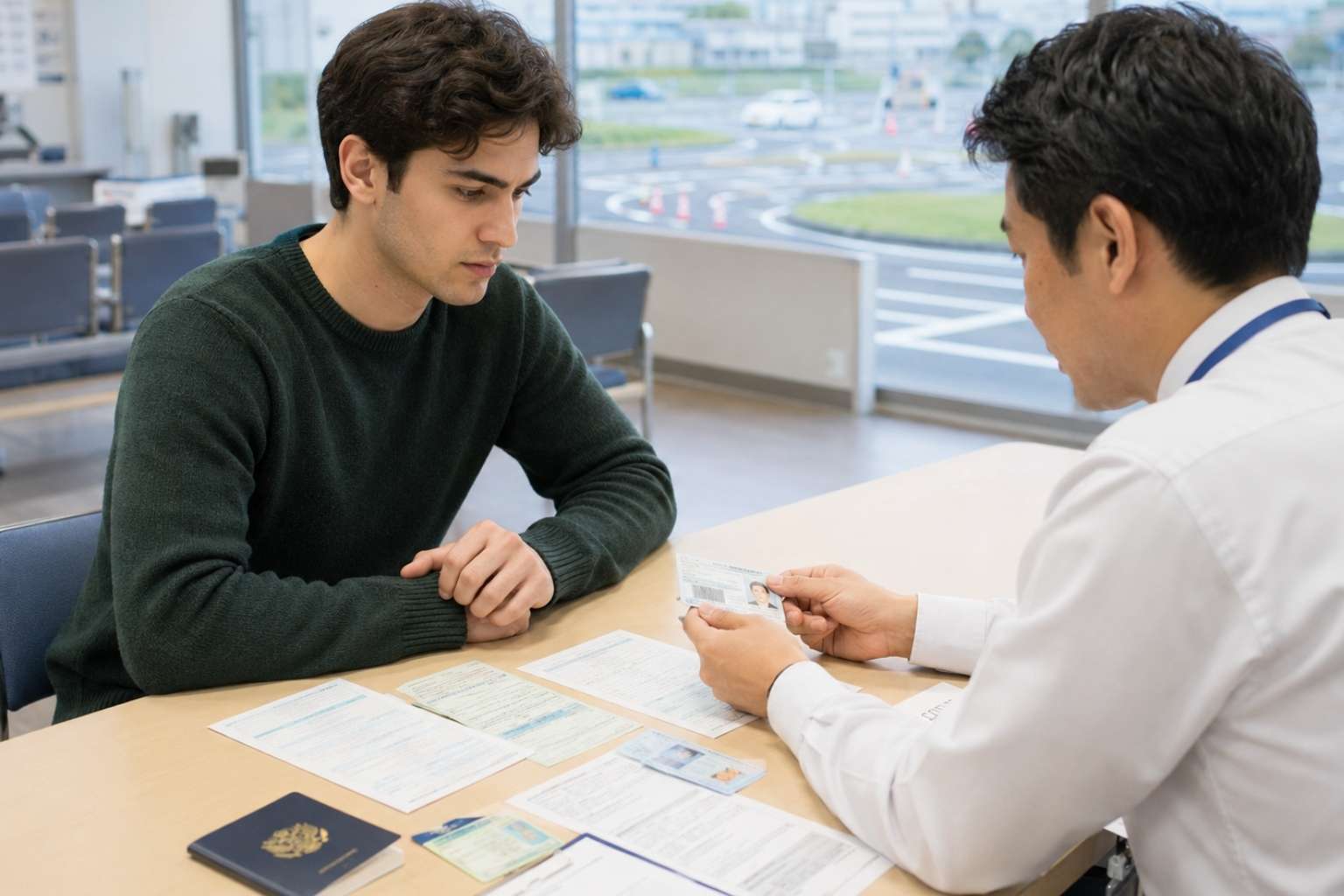
Japan has tightened the process for converting a foreign driver’s license into a Japanese one.
The change affects foreign residents who need to drive long term, and it matters now because the old easy-pass reputation is gone.
What was once treated as a light screening has turned into a much stricter knowledge, document, and road-test process with sharply lower pass rates.
The foreign license conversion Japan process, widely known as gaimen kirikae, has become much harder after stricter screening was introduced from October 2025. The most visible change is the written test, which expanded from a simple 10-question format to a 50-question exam with a much higher passing threshold. At the same time, licensing centers began applying tighter document checks and tougher practical driving standards.
That matters because official and media-reported data show the pass rates dropped fast after the changes. The written knowledge test pass rate fell from 92.5% in 2024 to 42.8% after the new format took effect, while the practical test pass rate dropped from 30.4% to 13.1%. For foreign residents who need a Japanese license for work, childcare, school runs, or daily life outside big cities, failing now means more time, more stress, and more repeat visits.
Foreign license conversion Japan: What Changed
The biggest shift is the written exam. Chiba Prefectural Police, one of the official licensing authorities publishing the revised format in English, says the test now includes 50 questions, the passing mark is 45 correct answers, and the time limit is 30 minutes. That means applicants can no longer rely on basic memorization or guesswork.
Before the change, many applicants faced a short illustrated true-or-false quiz that had a reputation for being manageable even with limited study. After the revision, questions became broader and more detailed, with realistic traffic-law scenarios and a much tighter margin for error. That is the practical reason the pass rate collapsed.
The practical test also became much harsher. Mainichi and other reports citing National Police Agency data said practical pass rates fell to 13.1%, suggesting that the road skills check is now being judged closer to the standard applied to new Japanese license candidates. Reports on the new format also say examiners are paying much closer attention to pedestrian priority, signaling, safety checks, lane discipline, and other small but important habits.
The document rules tightened too. Chiba Prefectural Police says all non-Japanese applicants must provide a residence certificate that includes all information from the residence card. Guidance from police and local international-association sources also reflects the broader October 2025 shift toward requiring a proper juminhyo rather than temporary or informal address proof.
That effectively shut the door on one practice that had drawn criticism: using short-term or temporary stays to access the conversion process. The newer guidance is built around actual residency documentation, not travel status, which means the process now clearly targets residents rather than tourists or short-term visitors. A Housing Japan guide summarizing the 2025 change also notes that short-term stay and tourist statuses are not eligible under the stricter framework.
Who Is Affected
This change affects foreign residents planning to stay in Japan long term and drive legally under a Japanese license. That includes work-visa holders, students, spouses, permanent residents, and other mid- to long-term residents who either cannot rely on an international permit anymore or need a full domestic license for everyday life.
It also affects applicants differently depending on where their original license was issued. Japan Automobile Federation explains that some countries and certain U.S. states may qualify for a simplified route, while others still face knowledge and practical testing. That means the experience is not identical for every foreign resident, and applicants should always check their issuing country’s category before assuming the full exam path applies.
In practical terms, the people most exposed are:
- foreign residents who need a Japanese license for commuting or family life
- people whose foreign license cannot be used in Japan for much longer
- new residents who assumed the conversion route was still easy
- applicants from countries that do not qualify for the most simplified exchange route
- people living outside major train networks where driving is essential
The change also hits people who are not well prepared for administrative delays. Some prefectural police offices now run document screening by appointment only, and real-world guides based on 2025 and 2026 procedures describe repeated visits, long waits, and retest delays if an applicant fails part of the process. In other words, the cost is not only exam difficulty. It is also time.
For people whose job or family schedule depends on driving soon, that can become a serious problem. A failed written or practical exam may not mean the end of the process, but it can mean waiting weeks for the next slot while still being unable to drive under a Japanese domestic license. That is why the fall in pass rates matters so much more than a simple headline number.
Old Rule vs New Rule
Old rule:
- short 10-question illustrated written test
- much higher knowledge-test pass rate
- looser public reputation around difficulty
- more room for applicants who were underprepared
- less visible pressure around residency documentation in public discussions
New rule:
- 50 questions in 30 minutes
- 90% passing score, meaning only five mistakes allowed
- much lower written-test pass rate
- much lower practical-test pass rate
- official residence certificate required for non-Japanese applicants in prefectural guidance such as Chiba’s
That difference explains why so many people are now shocked by the process. The older version built a public image of gaimen kirikae as a softer administrative shortcut. The newer version looks much closer to a serious licensing gate, even if it still allows some exemptions from the full Japanese driving-school route.
There is also a behavioral shift hidden inside the practical test. Reports and instructional summaries say small errors now matter more, especially around pedestrian crosswalks, visual safety checks, signaling timing, and overall driving etiquette. Applicants who can drive well in everyday life may still fail if they do not perform the exact test behaviors examiners expect.
That is why many candidates now treat the practical test less like a normal road check and more like a performance test on a controlled course. For some, the hardest part is not steering or braking. It is learning the precise rhythm of Japanese test-center driving culture.
[Japan’s New B2 Proof Rule Could Block Some Humanities Visa Renewals]
What Applicants Should Know Now
The first thing applicants need to confirm is eligibility. You generally need a valid foreign driver’s license, proof that you lived in the issuing country for at least three months after receiving that license, a Japanese translation from JAF or an embassy, your passport, your residence card, and a residence certificate issued within the recent validity window required by the licensing authority. Tokyo Metropolitan Police country-by-country guidance and prefectural police materials reflect these basic requirements.
The residence certificate point is especially important. Chiba’s English guidance says non-Japanese applicants must bring a residence certificate containing all residence-card information, while other police and local guidance also say the document should omit My Number and be acquired within the accepted period, often six months. That means old habits like using a hotel or temporary stay proof will not protect an application anymore.
A practical preparation checklist looks like this:
- confirm whether your country qualifies for a simplified exchange route
- gather passport records proving you lived at least three months in the issuing country after your license was issued
- order the official Japanese translation from JAF or confirm embassy translation rules
- obtain a current residence certificate with the correct residence details
- prepare for a 50-question written test, not the older 10-question version
- consider a practice lesson on a closed course before booking the road test
Study strategy matters far more now than it used to. Chiba police confirms the 50-question structure and 45-point passing line, while multiple guides built around the revised format say applicants should study realistic traffic situations, not only isolated vocabulary. Buying the JAF Rules of the Road book and drilling scenario-based questions is a much better approach than relying on old online summaries.
Applicants should also treat the practical test like a coached skill, not a casual check. The very low pass rate suggests that many capable drivers fail because they do not understand how examiners score observation checks, lane positioning, railroad-crossing behavior, crosswalk priority, and signaling timing. A single practice lesson built around Japanese testing habits may save weeks of delay later.
Another thing to watch is regional variation. The core national tightening is real, but prefectural police offices control appointments, local document flow, and some operational details. That means applicants should always follow the rules of the exact licensing center they will use instead of depending on a friend’s experience from another prefecture.
Fees should also be checked locally before booking. Your raw notes correctly warned not to publish a guessed number without confirming it. Because prefectural centers handle their own fee display and procedure steps, the safest public guidance is simply to verify the current fee with the local licensing center before your visit.
[Japan’s Visa Fee Shock Could Punish Anyone Who Waits]
Official Note
According to prefectural police guidance and national reporting on National Police Agency data, Japan’s foreign license conversion process became significantly stricter from October 2025. The written test is now 50 questions with a 90% passing mark in official prefectural guidance such as Chiba’s, while reported national pass rates fell from 92.5% to 42.8% for the knowledge test and from 30.4% to 13.1% for the practical test after the revised screening began.
For foreign residents, that changes the meaning of the process completely. What used to feel like an administrative conversion now behaves more like a serious license examination, with stricter residency proof, much lower pass rates, and far less room for improvisation.
If you need to drive in Japan long term, the smartest move now is not confidence. It is preparation, paperwork, and realistic timing. Waiting until the last minute, assuming the old easier system still exists, or walking in without targeted study is exactly how applicants get trapped in repeat failures and long appointment delays.
Information in this article is based on reports and official guidelines available at the time of publication and is for general informational purposes only. Japanese policies, prices, and event details change frequently. Always verify directly with official sources or licensed professionals before making travel, financial, or legal decisions.
Question for readers: Have you tried foreign license conversion in Japan under the new rules, and was the 50-question test or the practical exam the harder part for you?