
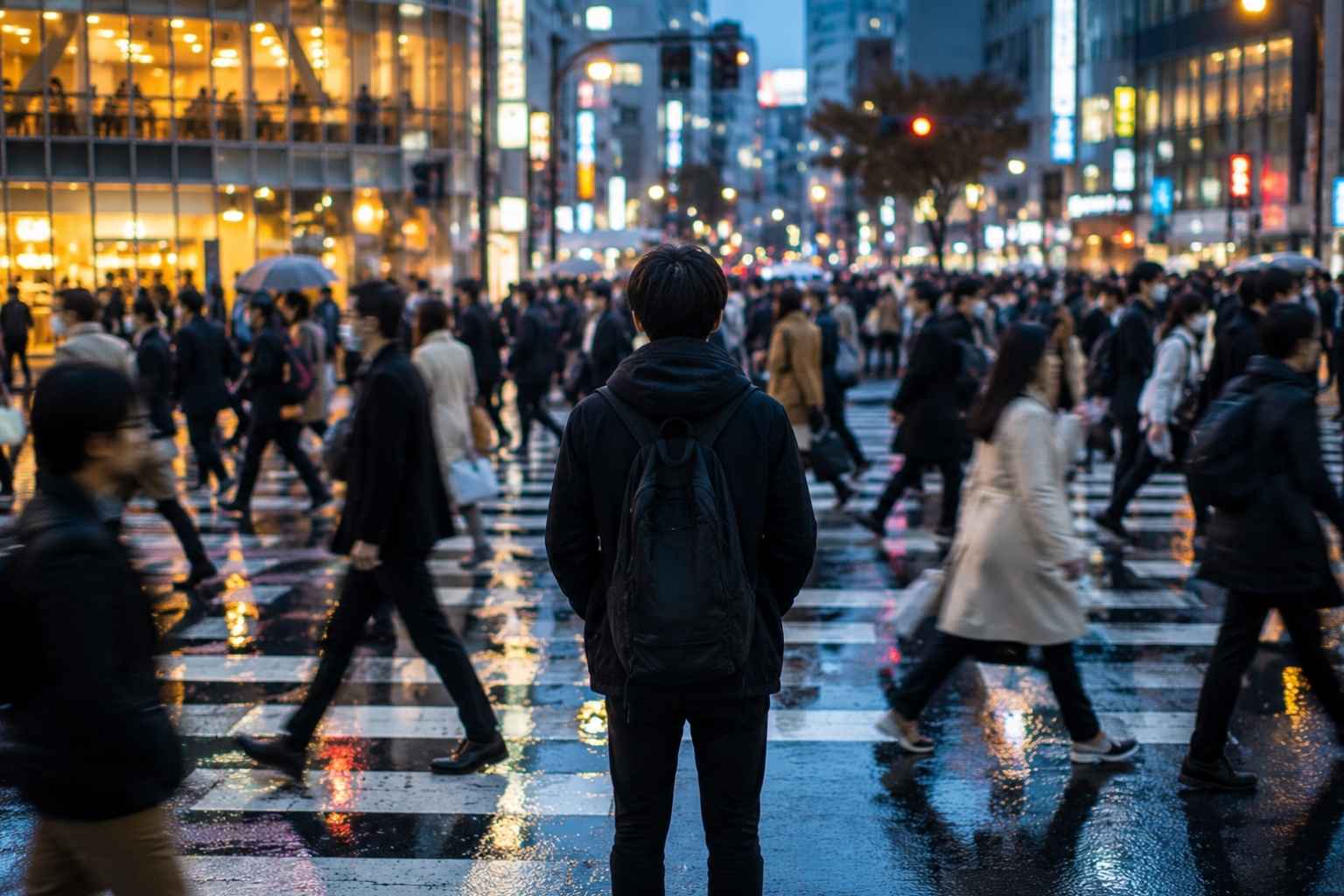
A first-person reflection on how a polite society can still leave you feeling deeply alone.
For anyone who has ever been surrounded by kindness and still felt completely outside it.
This is about the loneliness I have felt living in Japan, and why politeness did not protect me from isolation the way I thought it would. It will resonate with anyone who has moved here hoping kindness, order, and social harmony would naturally lead to connection. It matters because one of the hardest truths about life in Japan is that being treated well is not the same as being brought close.
When I first came here, I mistook surface kindness for acceptance.
Everything felt gentle. People were considerate. Service was careful. Daily life ran with a kind of social smoothness that made the whole country feel safe, civilized, and emotionally controlled.
At first, that felt like relief.
Then it started feeling cold.
Why This Story Hits Hard
The loneliness here is hard to explain because it does not come from open hostility.
It comes from distance.
That is what makes it hit so much harder than rudeness in other countries. If someone is openly dismissive, at least the message is clear. In Japan, the interaction can be polite, respectful, and technically pleasant while still making you feel like you never got within reach of another human being.
That is the difference between surface-level kindness and actual acceptance.
People can be kind to you here without ever letting you in. They can help you, smile at you, speak softly to you, and still keep a wall standing the entire time. That wall is what wears you down.
I used to think the language barrier was the main problem.
It was not.
Language mattered, of course. But for me, that was only a small part of it. The deeper barrier was cultural. Knowing the words did not automatically tell me when I was too direct, too open, too present, or too emotionally visible for the space I was in.
That was where the exhaustion really lived.
The Expectation vs Reality Shift
Before I lived here, politeness looked like warmth.
From the outside, Japan’s etiquette feels almost comforting. Everything is careful. Everything is measured. Nobody wants to inconvenience anyone else. It creates the impression of a society built on respect.
And in many ways, it is.
But the longer I lived here, the more I understood the hidden cost of that structure. So much of social life is built around smoothness, restraint, and not disrupting the atmosphere. That makes public life easier. It does not always make private connection easier.
Real friendship needs friction.
It needs awkward moments, messy honesty, and the risk of saying the wrong thing. It needs people willing to move beyond perfect behavior and into something less controlled.
That is where I kept feeling the gap.
Politeness made daily life easier to move through. It did not make deeper belonging easier to build.
What Changed Mentally
For a long time, I thought the answer was to get better at fitting in.
Be more careful. Be more correct. Read the room better. Speak more naturally. Filter more. Take up less space. Learn the rules so well that one day I would stop feeling outside them.
That day never came.
And that realization hurt because it forced me to stop blaming myself in the simple way I wanted to. The problem was not that I had failed to try. The problem was that I had been chasing a version of inclusion that may never have been fully available in the way I imagined.
That changed how I understood loneliness here.
- Surface kindness can make isolation harder to name
- Polite distance can feel colder than open rudeness
- Constantly performing “correct” behavior becomes emotionally draining
- The deeper barrier is often cultural, not just linguistic
Once I saw that clearly, the whole experience became more painful, but also more honest.
The Hardest Lesson
The hardest lesson was accepting that I may never fully fit in here.
Not because I failed.
Not because Japan is cruel.
But because social belonging here is shaped by layers I cannot simply study my way into. There are things you can learn, and then there are things you are expected to have absorbed from the beginning.
That is the painful line.
I spent too long trying to cross it.
I kept thinking if I improved enough, adapted enough, softened enough, I would finally stop feeling like I was standing just outside the circle. But wanting to fit in and actually being folded in are not the same thing.
That is what broke something in me for a while.
Because once you realize the wall is not temporary, you have to decide what to do with that truth.
What Living in Japan Revealed
Living in Japan revealed how lonely “kind but cold” can feel.
I do not say that to dismiss the culture. I say it because that is the emotional reality I have lived. It is possible to admire the care, the restraint, and the beauty of the social order here while also admitting that it can leave outsiders feeling unseen in a very specific way.
That kind of loneliness is different from chaos.
It is quieter.
And because it is quieter, it can settle deeper.
I stopped seeing this as a failure of language alone. Language was only part of the story. The larger truth was that cultural closeness is built through codes I can understand intellectually and still never fully own.
That is what made me stop chasing full belonging.
What I Understand Now
I do not think the answer is to hate Japan for this.
I think the answer is to stop lying about what it feels like.
Living here has taught me that politeness can make life smoother while still making real connection harder. It has taught me that being welcomed is not the same as being known. It has taught me that the most exhausting part of this life is not always what people expect.
It is the performance.
The constant effort to behave correctly enough that no one feels discomfort, while quietly knowing that correct behavior alone will never make you fully inside the culture around you.
Once I accepted that, something changed.
The loneliness did not disappear. But the self-blame became lighter.
Final Thought
Japan has given me many things: structure, beauty, discipline, and perspective.
It has also given me the most isolated feeling I have ever known.
Not because people were openly cruel, but because kindness without closeness can become its own kind of ache. That is the truth I wish more people said out loud before turning Japan into a simple fantasy of calm, order, and perfect social grace.
Sometimes the hardest place to feel alone is the place where nobody is ever openly unkind to you.
Question for readers: Would you rather live in a country that feels polite but cold, or rude but warm?