
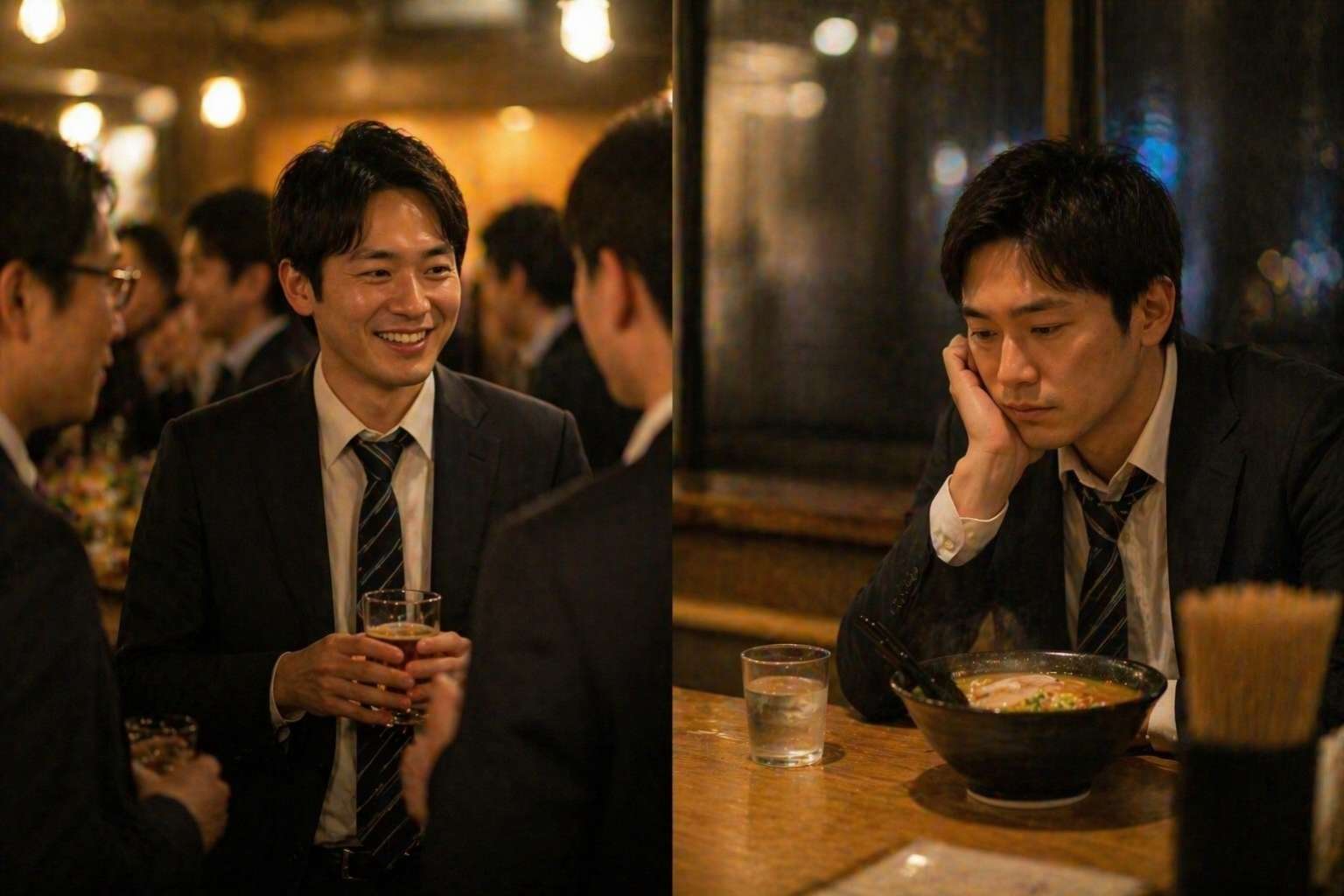
A practical guide to the social mask, emotional isolation, and real connection in Japan.
For foreign residents trying to fit in without slowly erasing themselves.
This guide covers honne and tatemae in Japan, why social life can feel full on the surface but emotionally empty underneath, and how that affects daily life over time. It is for foreign residents, long-term visitors, and anyone in Japan who feels surrounded by people but still strangely unknown. It matters now because many people hit this wall only after they seem to be “doing well,” which makes the loneliness harder to explain and easier to hide.
The hook is painfully familiar. You have 100 friends on LINE, you go to nomikais every Friday, and everyone tells you you’re “so kind.” So why does it feel like nobody actually knows you?
That is where this guide starts. Not with paperwork, visas, or systems, but with one of the most difficult parts of living in Japan: the pressure to perform a version of yourself that feels acceptable, smooth, agreeable, and easy to be around.
The public version is polished. You smile, you agree, you say the food is oishii even when it is bland, and you never complain. The private version is more honest, more tired, more frustrated, and often locked away at home.
For many people, that gap gets wider the longer they stay. The harder they try to fit in, the more invisible the real person inside that effort becomes.
Why This Guide Matters
This issue matters because it is not about one awkward dinner or one fake smile. It is about what happens when a social survival strategy slowly becomes your personality in public.
At first, tatemae can feel useful. It helps you avoid friction, move through group settings smoothly, and stay on good terms with the people around you. It can make life feel safer, especially when you are still learning how people communicate and what is expected.
But there is a cost when that public face becomes constant. The more often you perform harmony without real emotional honesty, the easier it is to become socially active but personally unseen.
That is the core of the “Honne Trap.” You can be popular, included, and praised, and still feel deeply lonely. You can spend years becoming a “Perfect Resident” and then realize you have not had one real, raw conversation in months.
That is why this topic hits so hard. It moves beyond culture shock as entertainment and gets into the emotional reality of daily life in Japan. The problem is not simply that social rules are different. The problem is that adapting too well can sometimes make you disappear.
This also explains why the topic triggers emotional debate. Some people see tatemae as respect, maturity, and social intelligence. Others experience it as emotional distance, suppression, and a slow kind of self-erasure. Both reactions exist because the same system can feel protective to one person and painful to another.
For foreign residents especially, the pressure gets complicated fast. You are not only learning how to function in a new country. You are also learning which parts of yourself feel welcome, which parts feel risky, and how much of your true personality you can show without causing discomfort.
That emotional math gets exhausting. Over time, what once felt like “integration” can start to feel more like disappearance.
What This Is and Who Needs It
This is an evergreen social survival guide for people who feel stuck between outward belonging and inward isolation. It is not a mental health manual, and it is not pretending that one article solves loneliness. It is a practical guide to understanding the gap between public harmony and private honesty, and what to do when that gap starts draining you.
This guide is especially for people who recognize any of these patterns:
- You are invited out often but rarely feel fully known
- People describe you as kind, easygoing, or well-adjusted, but that version feels incomplete
- You have a “Japan personality” and a different “home personality”
- You avoid saying what you really think because the social cost feels too high
- You feel emotionally tired after group settings even when nothing “bad” happened
- You have friends around you but still feel alone at the end of the day
It is also for people who have started wondering whether the version of harmony they built is actually sustainable. That question matters because social success from the outside can hide emotional strain on the inside.
The raw details make this especially clear. You can have the appearance of connection and still feel like the real you is locked in a box at home. That is not a failure of character. It is a sign that the balance between honne and tatemae may be off.
The “Invisible Feeling” is what often turns this from a normal adjustment issue into a deeper one. The more effort you pour into becoming socially correct, the more you may start to lose access to your own spontaneity, opinions, frustration, humor, and directness.
That is when people start saying things like, “I don’t know who I am here anymore.” They are not always being dramatic. They are describing what it feels like when social adaptation becomes too total.
Costs, Documents, or Setup Steps
There may be no official form for this problem, but there is still a cost. The cost is emotional energy, social fatigue, and the quiet loneliness that builds when people know your public face but not your real self.
The practical setup starts with understanding the two sides clearly.
Tatemae is the public face. It is the version of you that smooths things over, keeps interactions comfortable, and avoids unnecessary conflict. In your raw details, it shows up as smiling, agreeing, praising the food, and never complaining.
Honne is the true feeling underneath. It is the frustrated, tired, opinionated, unfiltered part of you that does not always fit the atmosphere of public harmony.
The problem is not that tatemae exists. The problem begins when tatemae becomes the only version of you that other people ever see.
A practical first step is to audit your current social life honestly. Ask yourself:
- Who only knows my polite version?
- Who has heard me speak honestly without me editing myself first?
- In which settings do I feel most performative?
- In which settings do I feel most real?
- How often do I leave a social event feeling connected, not just included?
This kind of audit matters because popularity and connection are not the same thing. A full calendar can still hide a very empty emotional life.
The next step is to identify your “mask-heavy” zones. These are the spaces where the pressure to be smooth and agreeable is strongest. For many people, that includes:
- Work parties
- Friday nomikais
- Group dinners
- Social circles built on politeness more than depth
- Situations where everyone expects easy emotional tone
Once you can see those zones, the goal is not to reject them entirely. The goal is to stop depending on them to meet your deeper emotional needs.
Here is a practical setup that helps:
- Keep your surface social life in perspective
- Stop measuring closeness by how often people invite you out
- Notice where you feel watched, edited, or overly careful
- Notice where you feel relaxed enough to speak naturally
- Make room for fewer but more honest conversations
That is where the breakthrough in your raw details becomes important. The people who become real friends are often the ones who are also tired of the mask. Real connection starts when someone risks dropping the performance first.
[Moving to Japan Meant Letting My Old Self Go]
Common Mistakes and Practical Tips
One common mistake is confusing acceptance with intimacy. Being included in group settings, praised for being kind, or invited to regular gatherings can feel like proof that you are deeply connected. Sometimes it is. Sometimes it is just proof that you are socially easy to manage.
Another mistake is turning “being perfectly Japanese” into your main social goal. That can look admirable from the outside, but it often leads to the exact problem described in your raw details. You start fitting in so effectively that the real you barely appears at all.
A third mistake is waiting for deeper friendship to happen automatically. If every interaction stays safely inside tatemae, nothing naturally breaks the pattern. The relationship can stay pleasant for years without becoming personal.
These practical tips help:
- Stop treating smoothness as the same thing as closeness
- Let one honest opinion exist in a safe conversation instead of agreeing to everything
- Notice which people seem relieved when someone speaks more honestly
- Pay attention to emotional reciprocity, not just politeness
- Reduce time spent in social spaces that leave you feeling more invisible than comforted
It also helps to stop viewing every social interaction as a performance review. When you are constantly managing tone, expression, opinions, and reactions, you do not just communicate less honestly. You also become harder for other people to know.
That is one reason loneliness can feel worse in a crowd. The issue is not the number of people around you. It is the amount of yourself that is actually present.
Another practical tip is to separate harmony from sameness. Your raw details make an important point here: true harmony is not about everyone being the same. It is about being real.
That is a crucial shift. If harmony only exists when you suppress discomfort, hide opinions, and keep the real version of yourself behind closed doors, the price becomes too high. If harmony can include sincerity, then connection becomes possible again.
A useful self-check is this:
- Do I feel calmer after seeing this person, or more drained?
- Did I say anything real, or only socially correct?
- Did the conversation reveal anything human, or just pass politely?
- Am I maintaining relationships, or actually building them?
These questions are simple, but they expose a lot. They help you see whether your social life is giving you belonging or only appearances.
What To Do Next
If this guide feels uncomfortably accurate, the next step is not to blow up your entire social life. It is to create more room for sincerity inside it.
Start small. You do not need to turn every dinner into a confession or reject every polite norm around you. You only need to stop making perfection the price of participation.
Look for one person who seems tired of the performance too. The raw details point clearly in this direction. Real friendship often begins with the people who are also exhausted by the mask.
That may mean speaking a little more honestly in a one-to-one setting. It may mean admitting you are tired, frustrated, lonely, or unsure instead of defaulting to the polished version of yourself. It may mean noticing who responds with relief instead of discomfort.
It also helps to build emotional contrast into your life. If your week is full of group settings, make sure at least some part of it includes space where you do not have to perform. The goal is not isolation. The goal is recovery and clarity.
Most importantly, stop telling yourself that disappearing is the same thing as integrating. That belief causes enormous damage over time. You can respect the culture, understand the atmosphere, and still protect a truthful version of yourself.
There is nothing wrong with tact. There is nothing wrong with reading the air. The danger begins when every social success depends on locking your real feelings away.
The breakthrough is not becoming fearless or brutally direct. It is becoming more real in the places where realness has room to live.
[Japan Looked Perfect. I Still Felt Alone.]
Official Note
This guide is based on the lived social dynamic described above, including the contrast between honne and tatemae, the pressure to fit in, and the loneliness that can grow when the public version of you becomes stronger than the private one. It is a practical lifestyle guide, not an official rulebook, and the most useful test is still your own daily experience of whether your relationships in Japan feel merely polite or genuinely real.
[I Thought Honesty Was Respect. Japan Taught Me Otherwise.]
A full social life can still feel emotionally empty when the real you never gets to show up. Sometimes the hardest part of living in Japan is not being excluded. It is being included as a version of yourself that no one truly knows.
Question for readers: How long did it take you in Japan to find someone you could actually be yourself around, and do you feel like you still wear a different social mask here?